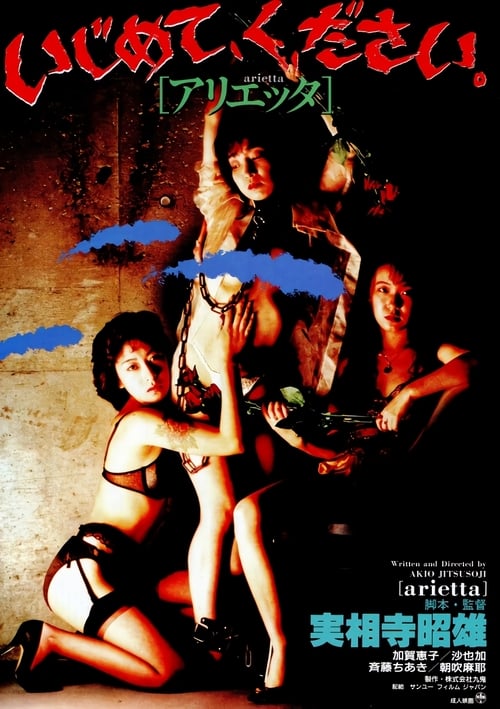
Arietta
Plot
A young widow becomes an SM call girl to pay off the debts accumulated by her yakuza husband. She's a depressed woman, merely going through the motions of existence, subjected to every cruel whim concocted by her clients. She's dedicated to the misery - even finding comfort in it - stumbling through life like a zombie.
Get the Weekly Woke Watchlist
New and trending movies scored for woke bias, preachy messaging, and forced political themes — before you waste your evening.
No spam. One useful email per week.
Overall Series Review
Categorical Breakdown
The movie is a Japanese production focused entirely on Japanese characters and a domestic crime/exploitation crisis. The narrative centers on economic and personal desperation, not race, immutable characteristics, or intersectional hierarchy. There is no vilification of 'whiteness' or forced diversity, as the film is culturally specific and authentic to its setting.
The film critiques the brutal criminal element (yakuza) and the specific, dark economic realities that force the protagonist into prostitution. This is a critique of a corrupt subculture, not a wholesale demonization of core Japanese civilization, its institutions, or its ancestors. The focus is specific, not a broad civilizational self-hatred.
The female protagonist is a depressed, 'zombie-like' victim subjected to 'every cruel whim.' This portrayal is antithetical to the 'Girl Boss' or 'Mary Sue' trope, as the character is deeply flawed and non-triumphant, dedicated to her own misery. While the men (yakuza husband, clients) are cruel exploiters, their emasculation is incidental to their role as villains in an exploitation drama, not a modern political critique.
The core plot focuses on a widow and the economic-sexual consequences of her heterosexual marriage to a yakuza member, leading to SM call girl work for predominantly male clients. The structure is normative (male-female pairing/transactional sex) in its focus, and there is no evidence that the film centers on alternative sexualities, deconstructs the nuclear family politically, or includes gender ideology lecturing.
The plot's focus is on debt, criminality, and the protagonist's emotional/physical degradation. The spiritual vacuum is a result of the character's nihilistic situation and despair, which is a thematic element of the exploitation genre, not a political attack on organized religion. As a Japanese film, the category's focus on anti-Christianity is irrelevant, and there is no indication of hostility toward local spiritual traditions.
Get the Weekly Woke Watchlist
New and trending movies scored for woke bias, preachy messaging, and forced political themes — before you waste your evening.
No spam. One useful email per week.