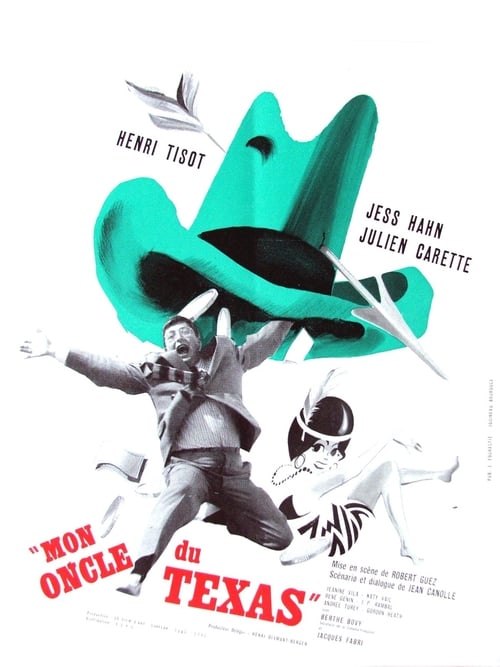
My Uncle from Texas
Plot
In 1911, Arnolphe Combalette left his corner of Provence to seek his fortune in the Americas. Fifty years later, a letter from him arrived in the village: "No, I'm not dead yet, but it won't be long now. A Combalette should be sent here to settle a question of big money". The family took counsel and delegated their youngest son, Dieudonné, a cook by trade. Dieudonné arrived safely in New York, but soon found himself short of money. Somehow, he managed to reach that prodigious corner of Texas where, he thought, his uncle's many factories would be built. Neither the factories nor his uncle, who died in poverty a week ago, welcome him there. Dîeudonné can't imagine returning to his native village to announce this new family disgrace; for one thing, he hasn't got a penny in his pocket. The owner of a modest saloon hires him as a cook.
Get the Weekly Woke Watchlist
New and trending movies scored for woke bias, preachy messaging, and forced political themes — before you waste your evening.
No spam. One useful email per week.
Overall Series Review
Categorical Breakdown
Characters are judged solely by their financial status, their personal failures, or their professional competence as a cook. The core plot engine is the merit of the male protagonist’s Provençal cooking, which allows him to find success after his financial setback. Casting and character dynamics are historically authentic for a French-American comedy of the era with no forced insertion of diversity or vilification of 'whiteness.'
The film satirizes the French family's preoccupation with money and their misplaced pride, but it does not frame French culture as fundamentally corrupt. The protagonist's success is achieved *through* his Provençal culinary heritage, not despite it, reinforcing the value of his home culture. The American setting is portrayed as a land of opportunity, embodying the 'American Dream,' rather than a corrupt civilization that must be condemned.
The main action revolves around the male protagonist's quest for fortune. Female characters, such as the grandmother, occupy traditional, protective, or supporting roles in the family structure. The narrative does not feature a 'Girl Boss' trope, the emasculation of males, or anti-natalist themes. Masculinity, represented by the cook's professional skill and enterprising spirit, is protective and generative of success.
The story is a straightforward comedy about family, inheritance, and financial success in 1962, focusing on normative social structures. Alternative sexualities or gender ideology are not present in the narrative. The nuclear family remains the standard without any deconstruction or political lecturing on sexuality.
Religion, specifically Christianity, is absent as a thematic focus or source of conflict. The conflict is purely secular, centering on a financial inheritance and subsequent professional enterprise. The story operates within a traditional moral framework that values family reputation, hard work, and ingenuity, suggesting an acknowledgement of Objective Truth rather than moral relativism.
Get the Weekly Woke Watchlist
New and trending movies scored for woke bias, preachy messaging, and forced political themes — before you waste your evening.
No spam. One useful email per week.