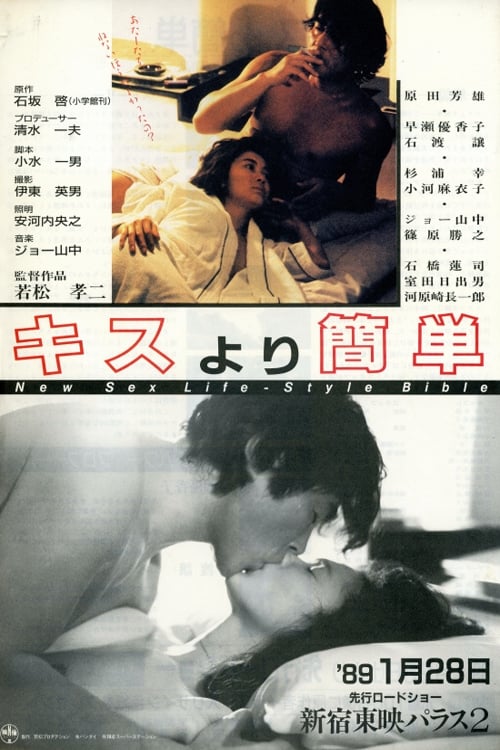
It's Easier Than Kissing
Plot
After the death of her mother a young woman wants to meet her real father
Get the Weekly Woke Watchlist
New and trending movies scored for woke bias, preachy messaging, and forced political themes — before you waste your evening.
No spam. One useful email per week.
Overall Series Review
Categorical Breakdown
The film is a Japanese production from 1989 and focuses its social critique on local issues and sexuality, not on immutable characteristics, race, or Western intersectional hierarchy. The narrative does not contain any vilification of 'whiteness' or forced diversity.
The director, Koji Wakamatsu, is known for his history of making politically and socially critical films that challenge mainstream Japanese society. The film's critique is aimed at the restrictive nature of traditional Japanese social conventions and morality, not at a historical Western civilization or its institutions. This critique of the home culture warrants a low-to-moderate score.
The core of the narrative is the protagonist's quest for self-determination and an independent identity outside of the traditional nuclear family structure. The alternative title, 'New Sex Life-Style Bible,' indicates an endorsement of sexual liberation and a new lifestyle, which directly rejects the traditional view of motherhood as celebrated and masculinity as protective, aligning with anti-natalist and anti-family messaging for the sake of career/personal fulfillment.
The genre and the film's reputation center on exploring alternative sexualities, sexual freedom, and non-normative relationships outside the traditional male-female pairing. The content directly deconstructs the nuclear family and treats sexuality as a key component of the new life-style it advocates, pushing the score into the higher range for its emphasis on non-normative structures.
The film's focus is on social and sexual liberation, not on religion or specific anti-Christian themes. The movie rejects a moral framework based on traditional, transcendent religious law and instead embraces a subjective morality of personal freedom. The focus on secular transgression, rather than an explicit attack on faith, places the score in the middle range.
Get the Weekly Woke Watchlist
New and trending movies scored for woke bias, preachy messaging, and forced political themes — before you waste your evening.
No spam. One useful email per week.