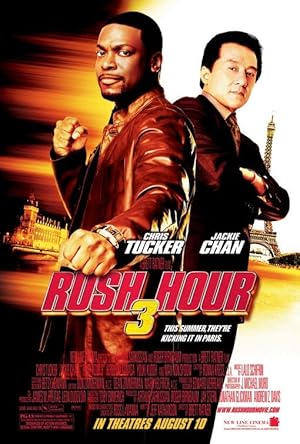
Rush Hour 3
Plot
Almost three years after their last adventure in Rush Hour 2 (2001), Carter is now working as a Los Angeles traffic officer, while his friend and ace Hong Kong Police inspector, Lee, escorts the Chinese Ambassador, Han, to the World Criminal Court, to disclose crucial information about the Triads. However, after a botched assassination attempt, the mismatched duo will find themselves in picturesque Paris, struggling to retrieve a precious list of names, as the murderous crime syndicate's henchmen try their best to stop them. Once more, Lee and Carter must fight their way through dangerous gangsters; however, this time, the past has come back to haunt Lee. Will the boys get the job done once and for all?
Get the Weekly Woke Watchlist
New and trending movies scored for woke bias, preachy messaging, and forced political themes — before you waste your evening.
No spam. One useful email per week.
Overall Series Review
Categorical Breakdown
The movie utilizes an extensive array of racial and ethnic stereotypes for comedic purposes, a technique that relies on immutable characteristics rather than merit-based humor. A trusted, patrician Caucasian official who leads the World Criminal Court is ultimately revealed to be the main villain, a trope explicitly noted by Detective Carter.
The narrative places the protagonists in Paris, making them 'fish out of water,' and employs stereotypes to mock the local French culture, such as an American-style car chase 'electrifying' a French cab driver into adopting American slang. The film's energy celebrates American and Hong Kong policing vitality over European institutions, which is the reverse of civilizational self-hatred.
Female characters are frequently subjected to sexual objectification and recurring gratuitous cheesecake shots. The main female figure connected to the central plot is a mysterious dancer whose life is framed as a 'martyrdom' in service of a male-dominated secret society. Another key female character, Soo Yung, requires rescuing by the male protagonists. Comedy also involves a man questioning a woman’s gender for having a bald head.
The story adheres to a normative structure, with no centering of alternative sexualities or messaging on gender ideology. Detective Carter's character is constantly attempting to pursue women, and the core relationship is a non-sexual male-male partnership. There are no explicit references to or lectures on queer theory.
The movie is focused entirely on a criminal investigation, action, and comedy. Morality is a straightforward, objective struggle between the police and a criminal syndicate (the Triads). No traditional religion, specifically Christianity, is targeted with hostility or depicted as a source of evil.
Get the Weekly Woke Watchlist
New and trending movies scored for woke bias, preachy messaging, and forced political themes — before you waste your evening.
No spam. One useful email per week.