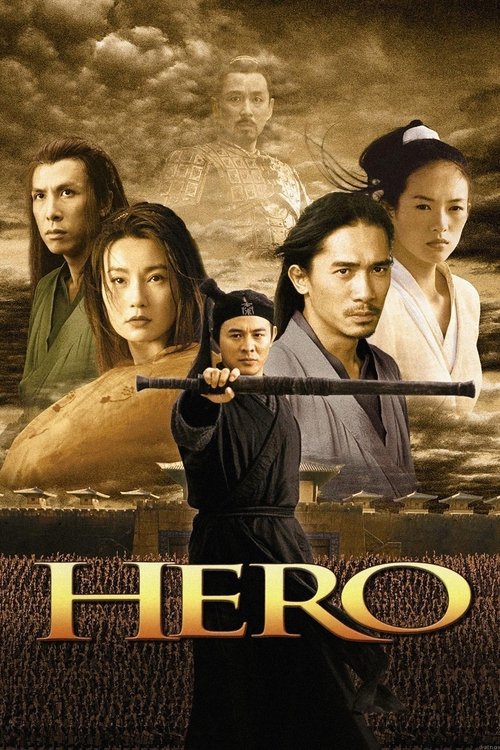
Hero
Plot
During China's Warring States period, a district prefect arrives at the palace of Qin Shi Huang, claiming to have killed the three assassins who had made an attempt on the king's life three years ago.
Get the Weekly Woke Watchlist
New and trending movies scored for woke bias, preachy messaging, and forced political themes — before you waste your evening.
No spam. One useful email per week.
Overall Series Review
Categorical Breakdown
The narrative is entirely focused on a historical and philosophical debate within ancient Chinese civilization, pitting the concept of 'All Under Heaven' (tianxia) against individual revenge. Character merit is measured by martial skill, philosophical understanding, and commitment to a national ideal. There is no intersectional lens, race-swapping, or vilification of 'whiteness,' as the casting is historically authentic to its Chinese setting. The final choice of the hero is a transcendent moral decision, not one based on immutable characteristics.
The film takes a stance that is explicitly pro-civilizational, arguing that the chaotic Warring States period must end for the sake of the collective Chinese people. It rehabilitates the image of the historically brutal King of Qin to portray him as a necessary, strong leader whose unification is a moral imperative that guarantees long-term peace and stability for the nation. This theme is an endorsement of its own cultural and political foundation—the antithesis of civilizational self-hatred.
The female characters, Flying Snow and Moon, are formidable, highly skilled martial artists who are equals to the male assassins in combat and plot significance. Their character arcs involve great personal sacrifice and a powerful sense of passion and conviction. While they are strong, they are not portrayed as 'Girl Boss' tropes; their motivations are interwoven with love, loyalty, and their relationships with the male heroes, which avoids the modern trope of defining female success solely through the emasculation of men or anti-natal messaging.
The movie contains no centering of alternative sexualities, deconstruction of the nuclear family, or explicit gender ideology lecturing. All core romantic and familial relationships depicted are normative male-female pairings. Sexuality is not a central theme or an explicit focus of the narrative conflict.
The conflict is deeply philosophical, hinging on a transcendent moral question about the value of an individual life (the King) versus the collective peace of the nation. Concepts of honor, duty, and 'the way' (Dao) function as a higher moral law that guides the hero’s ultimate decision and self-sacrifice. Traditional religion is neither vilified nor centered; instead, the film acknowledges an Objective Truth found in the ethical imperative for peace and order.
Get the Weekly Woke Watchlist
New and trending movies scored for woke bias, preachy messaging, and forced political themes — before you waste your evening.
No spam. One useful email per week.