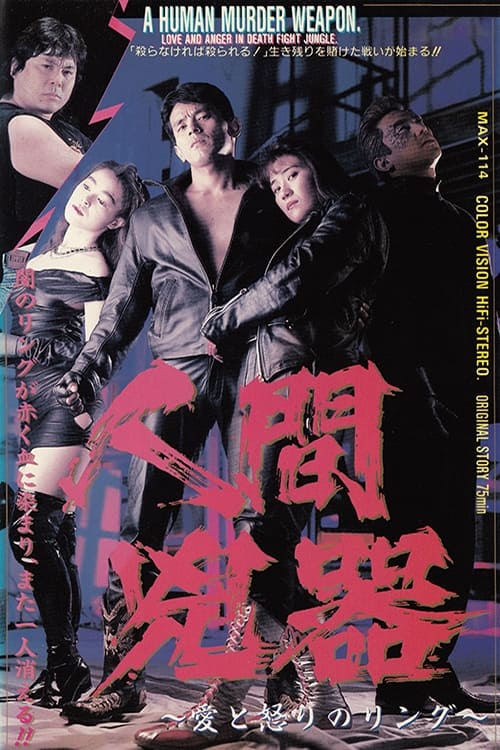
A Human Murder Weapon
Plot
A man dubbed "Karate Kid" is imprisoned and forced to fight for his life in an underground fighting ring.
Get the Weekly Woke Watchlist
New and trending movies scored for woke bias, preachy messaging, and forced political themes — before you waste your evening.
No spam. One useful email per week.
Overall Series Review
Categorical Breakdown
The narrative's central conflict is centered on a Japanese fighter and his community being exploited by a shady promoter and a 'mostly foreign audience' in an underground fight ring, which is an economic/criminal dynamic, not an intersectional hierarchy lecture. Characters are defined by their fighting skill and moral integrity (or lack thereof), not by race or other immutable characteristics.
The movie is Japanese and does not critique Western civilization. The antagonists are a corrupt promoter and criminal enterprise that preys on local fighters. The film's critique is aimed at a criminal subculture of exploitation, not at the foundational values, institutions, or ancestors of Japanese civilization, thus avoiding the criteria for oikophobia.
One female character, a non-combatant singer, is subjected to extreme exploitation, violence, and sexual degradation, directly contrasting the 'Girl Boss' trope. However, the protagonist's ex-partner is a formidable, experienced fighter and a mother, a character who is distinct and complementary to the male lead. The film does not have anti-natalist messaging, but the brutalization of a female character pushes the score above the baseline.
The promoter's henchmen are mentioned as 'two gay henchmen' and are positioned as minor antagonists and criminals, but the film's focus is entirely on the fight ring's criminal exploitation. There is no centering of sexual identity as a theme, no deconstruction of the nuclear family, and no lecturing on gender ideology. Sexuality is peripheral to the main crime/action plot.
The movie is a straightforward action/exploitation film set in a criminal underworld. There is no explicit mention or critique of religion, specifically Christianity, and the conflict is entirely physical and economic. Morality, while subjective to the criminals, is generally framed as objective good (saving the innocent) versus objective evil (exploitation and violence).
Get the Weekly Woke Watchlist
New and trending movies scored for woke bias, preachy messaging, and forced political themes — before you waste your evening.
No spam. One useful email per week.