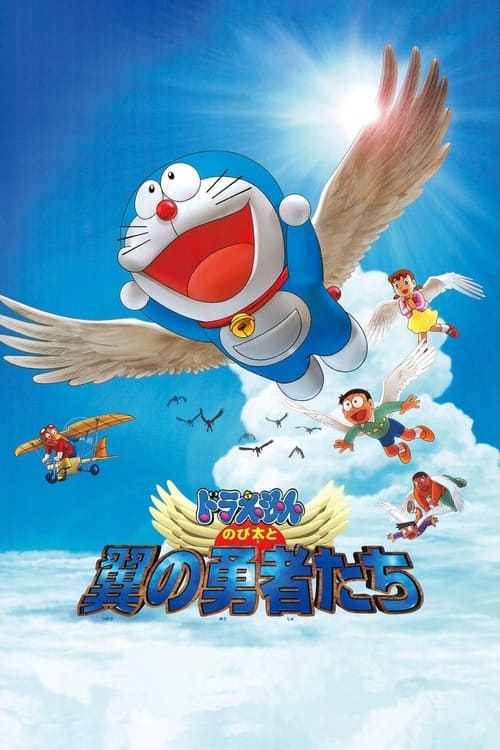
Doraemon: Nobita and the Winged Braves
Plot
Doraemon and his friends have to rescue the people of Birdopia from the wrongdoing of vengeful former bird troopers before they unleash a wicked ancient dragon.
Get the Weekly Woke Watchlist
New and trending movies scored for woke bias, preachy messaging, and forced political themes — before you waste your evening.
No spam. One useful email per week.
Overall Series Review
Categorical Breakdown
The narrative primary conflict involves 'fantastic racism' from the villain, Seagrid, who despises humans as a whole and seeks to destroy them for an injury he suffered. The story uses this prejudice to propel the plot, with the heroes' success depending on universal values like courage, friendship, and self-belief, rather than race or immutable characteristics. The central bird-boy, Gusuke, must overcome prejudice within his own society for not being a 'natural' flyer, which reinforces the theme of meritocracy over birth status.
The villain’s motivation is explicit hostility toward the human world, seeking to wipe out mankind. However, this self-hatred is solely confined to the clear antagonist, a former bird trooper, whose plan is shown to be reckless and destructive. The hidden world of Birdopia was created by a 22nd-century human who disliked humanity, suggesting a preference for an 'other' civilization, which slightly elevates the score. The heroes, who are from the human world, fight to save both civilizations, affirming their own world's value.
The female lead, Shizuka, acts as a supportive friend who accompanies the male protagonists on their adventure. She is not depicted as an instantly perfect 'Girl Boss' and the movie does not emasculate the male leads, who drive the heroic action. The film includes depictions of protective and nurturing motherhood (both adoptive and biological) for the child hero, Gusuke. There is no presence of anti-natalist or anti-family messaging.
The movie contains no discernible themes relating to alternative sexualities, gender ideology, or the deconstruction of the nuclear family. Character relationships and structures are entirely normative, focusing on traditional male-female pairings and family dynamics within the Birdopia society.
The plot utilizes an ancient prophecy and a mythological dragon-like monster, Phoenicia, as the cataclysmic threat. The moral struggle is clearly defined as the battle between the heroes and the villain's destructive vengeance, which represents an objective good versus evil framework. There is no presence of anti-religious sentiment or the promotion of moral relativism.
Get the Weekly Woke Watchlist
New and trending movies scored for woke bias, preachy messaging, and forced political themes — before you waste your evening.
No spam. One useful email per week.