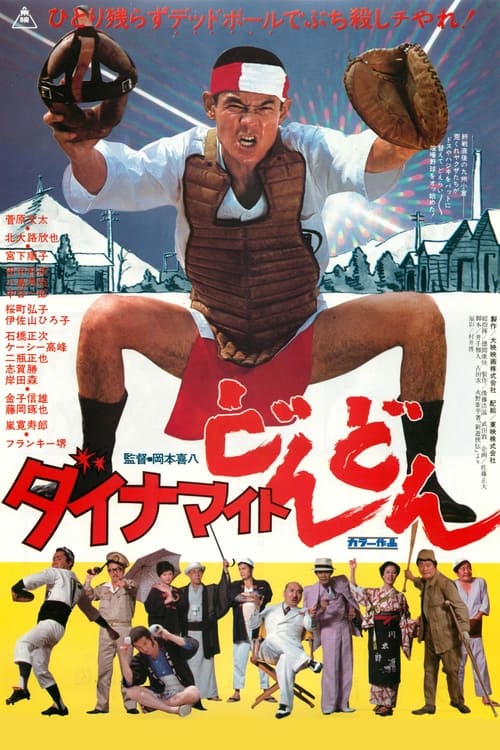
Dynamite Don-Don
Plot
Yakuza Gang War is at the height in North Kyūshū Area in the summer of 1950, particularly between the Okagen Group and the rising Hashiden Gang. Now with the mediation/interference of the Americans, they decide to settle it in a peaceful, *democratic* way, that is, to settle it with a baseball game. Now, with its money and power, The Hashiden group soon recruits a group of gamblers known to be good at baseball from the whole country. So, what is the Okagen Gumi gonna do?
Get the Weekly Woke Watchlist
New and trending movies scored for woke bias, preachy messaging, and forced political themes — before you waste your evening.
No spam. One useful email per week.
Overall Series Review
Categorical Breakdown
The core conflict is a territorial power struggle between two Japanese Yakuza gangs, resolved by a skill-based, meritocratic contest (baseball). Character definition comes from their role in the gang or their gambling/athletic ability, not from immutable characteristics or an intersectional hierarchy.
The film's satire focuses on the absurdity of the American occupation's "mediation" by forcing a "democratic" baseball game to resolve a Yakuza war. This is a critique of external cultural imposition on a local Japanese conflict, not a depiction of Western home culture as fundamentally corrupt or an exaltation of external cultures as morally superior.
The narrative is a genre piece centered on male-dominated Yakuza and gambling culture. Female characters exist in supporting or traditional roles, with no plot elements suggesting "Girl Boss" perfection, the systematic emasculation of males, or anti-natalist messaging.
The plot is a 1970s Japanese crime-action film focusing on male Yakuza power dynamics. The subject matter does not involve the centering of alternative sexualities, deconstructing the nuclear family, or lecturing on gender ideology.
The plot deals with the secular themes of organized crime, power, and competition. There is no thematic focus on religion, nor are there suggestions that traditional faith is the root of evil or that morality is purely subjective.
Get the Weekly Woke Watchlist
New and trending movies scored for woke bias, preachy messaging, and forced political themes — before you waste your evening.
No spam. One useful email per week.