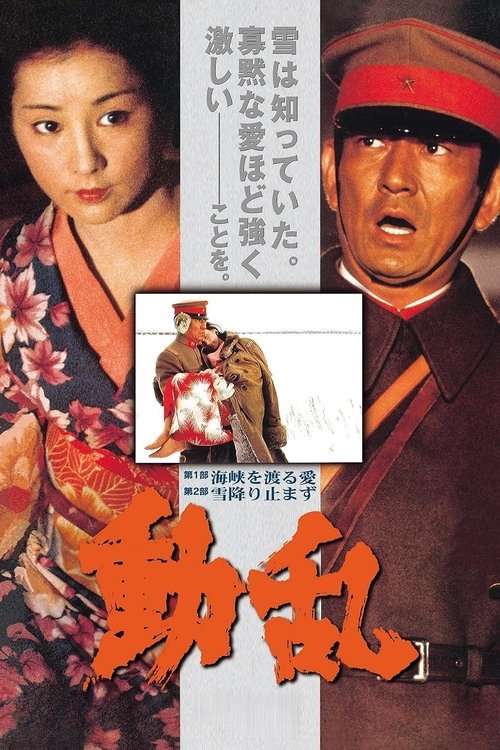
The Revolt
Plot
When a young soldier is killed while trying to prevent his younger sister, Kaoru, from being sold into a life of prostitution, his commander, Col. Miyagi, tries to honor his dying wish to rescue his sister. Upon finding Kaoru at a party working as a geisha and later rescuing her from committing suicide, Col. Miyagi allows her to move in with him. Over time, the two grow close, but in spite of Kaoru's growing feelings for him, Col. Miyagi is unable to bring himself to return her love. On the night of his deployment to war, Col. Miyagi finally admits his feelings for Kaoru, but will they ever be able to enjoy a peaceful life together now that a very violent and bloody military revolt is under way...
Get the Weekly Woke Watchlist
New and trending movies scored for woke bias, preachy messaging, and forced political themes — before you waste your evening.
No spam. One useful email per week.
Overall Series Review
Categorical Breakdown
The narrative is entirely focused on a specific, non-Western, ethnically homogeneous historical setting (1930s Japan). Character motivations are driven by military honor, political loyalty, and personal devotion. The concept of vilifying 'whiteness' or forcing intersectional diversity is completely absent. Characters are judged solely by their actions, duty, and emotional depth.
The central action is a violent military revolt against the established government, which critiques the current political institutions but is framed as a struggle for the soul of the nation, often rooted in an idealized view of ancestral or pure national values. This is an internal, nationalist critique of corruption, not a deconstruction or hatred of the civilization itself. The narrative operates within a framework of national sacrifice and duty, respecting the concept of 'home' and 'ancestors' even in revolt.
Kaoru’s story arc is defined by her vulnerability—being sold into prostitution, attempting suicide, and being rescued and cared for by a man. She serves as the emotional anchor for the male protagonist and is the object of his protective instinct. Her perfection is limited to her devotion; she is not a 'Girl Boss' and the movie does not contain anti-natalist or male-emasculating messaging. The gender dynamics are traditional and complementary, with masculinity as protective.
The core of the emotional plot is a turbulent love story between a man and a woman, Col. Miyagi and Kaoru. There is no presence of alternative sexual ideologies, deconstruction of the nuclear family unit, or any focus on gender identity or transitioning. The structure is entirely normative.
The setting is 1930s Imperial Japan, where soldierly duty and honor are often tied to national and spiritual ideals. The themes of sacrifice and duty suggest a transcendent moral framework rather than subjective power dynamics. There is no evidence of hostility toward religion, specifically Christianity, or the promotion of moral relativism; instead, honor and a soldier's dying wish are treated with gravity and moral weight.
Get the Weekly Woke Watchlist
New and trending movies scored for woke bias, preachy messaging, and forced political themes — before you waste your evening.
No spam. One useful email per week.