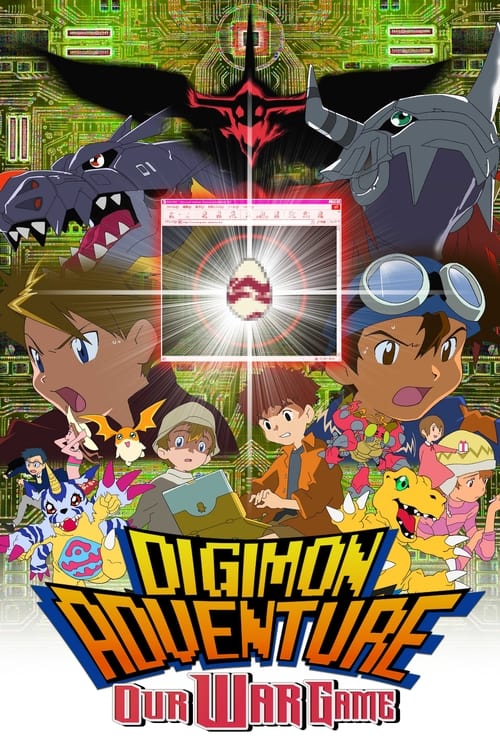
Our War Game
Plot
Spring break turns into a summer war when the evil Diaboromon wreaks havoc on the internet, and Tai and Matt must achieve a new Digivolution to defeat him! Will Tai and the Digidestined save the world, and will Sora ever forgive Tai for giving her a hair clip?
Get the Weekly Woke Watchlist
New and trending movies scored for woke bias, preachy messaging, and forced political themes — before you waste your evening.
No spam. One useful email per week.
Overall Series Review
Categorical Breakdown
Characters are judged entirely by their merit as the 'DigiDestined' and their courage to fight the villain. The core duo who fuse to form the ultimate hero are Tai and Matt, two boys who embody their respective crests (Courage and Friendship). The children who help solve the crisis from around the world are portrayed as a global community united against a universal threat, with no focus on race, privilege, or a vilification of any group.
The central crisis is an internet-based virus monster that commandeers a US-launched Peacekeeper nuclear missile, which threatens the children's hometown of Odaiba, Tokyo. The protagonists' entire goal is to protect their homes and the world from chaos, demonstrating a clear respect for their nation and civilization. The depiction of the US military's system failure is a minor critique of technology vulnerability, not a fundamental attack on Western civilization or Japanese heritage.
The story follows the two main male protagonists, Tai and Matt, who combine their Digimon to achieve the ultimate hero form. The female characters are integral parts of the team, with Sora being a major focus of Tai's emotional subplot, but the story does not center a 'Girl Boss' or feature a perfect, instantly powerful female lead. Males and females play distinct, complementary roles in the overall team effort. No anti-family or anti-natalist messages are present.
The narrative is a direct action-adventure plot focused on saving the world from a digital monster. Sexuality and gender identity are not a part of the story. The characters operate within a normative structure of traditional male-female pairings and nuclear families are portrayed neutrally or positively, with no deconstruction of this unit.
The film's conflict is purely a technological one: a rogue AI/virus causing catastrophic damage to the real world. The morality is objective, defining the virus as pure evil and the children's goal of saving the world as pure good. Religion and faith are not discussed, and there is no hostility toward traditional religious morality.
Get the Weekly Woke Watchlist
New and trending movies scored for woke bias, preachy messaging, and forced political themes — before you waste your evening.
No spam. One useful email per week.