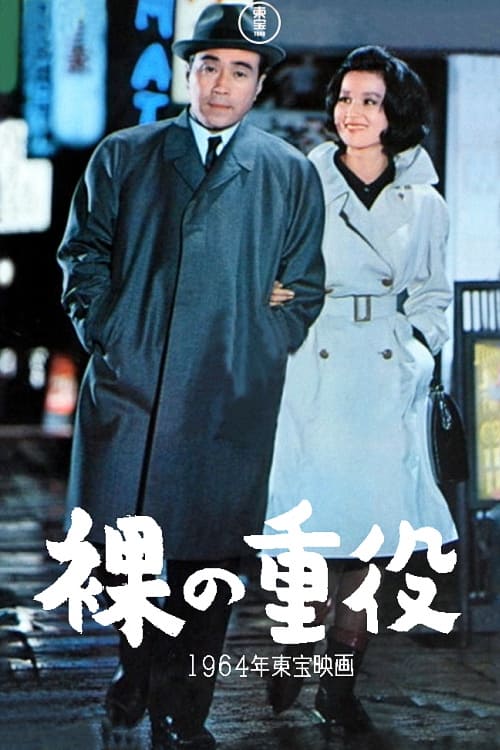
The Naked Executive
Plot
The executive director of the «Chuo Shoji» company, Hidaka Shiro, is called a "demon of work", but the hostess of the bar calls him "the loneliest person in Japan." He lost his wife ten years ago and has been living as a widower ever since. He plotted to marry off his 22-year-old daughter Keiko for political gain, but Keiko is in love with Okuda, who is her father's subordinate. A story full of sadness and joy, depicting a man gripped by different thoughts, as an employee of the company and a father.
Get the Weekly Woke Watchlist
New and trending movies scored for woke bias, preachy messaging, and forced political themes — before you waste your evening.
No spam. One useful email per week.
Overall Series Review
Categorical Breakdown
Characters are judged by their corporate status and social standing within the established Japanese hierarchy, reflecting a focus on universal meritocracy and a traditional conflict between love and status. The narrative is entirely focused on an intra-cultural, intra-racial drama.
The movie is a critique of a single executive's moral failings (workaholism, emotional isolation, manipulating his daughter's life) and the internal pressures of Japanese corporate culture. It does not display hostility toward Western civilization, one's home, or ancestors, nor does it frame Japanese culture as fundamentally corrupt.
The daughter, Keiko, exercises agency by rejecting the arranged marriage her father plots for 'political gain' and chooses a partner based on love. This is a traditional expression of romantic self-determination, not a 'Girl Boss' trope or a systematic emasculation of all males. The central male character is portrayed as a lonely and flawed man, but not as a 'bumbling idiot' or inherently 'toxic' due to his masculinity.
The narrative centers entirely on traditional male-female pairings and the conflict over forming a nuclear family (the daughter's marriage). There is no focus on alternative sexualities, deconstruction of the nuclear family, or gender ideology, aligning with the normative structure of a 1964 film.
As a corporate and domestic drama set in mid-century Japan, the film does not engage with Christian theology or anti-Christian themes. The morality in the story, based on honor, duty, and love, operates outside of a secular-versus-religious framework, acknowledging an implicit social/moral law without hostility towards faith.
Get the Weekly Woke Watchlist
New and trending movies scored for woke bias, preachy messaging, and forced political themes — before you waste your evening.
No spam. One useful email per week.