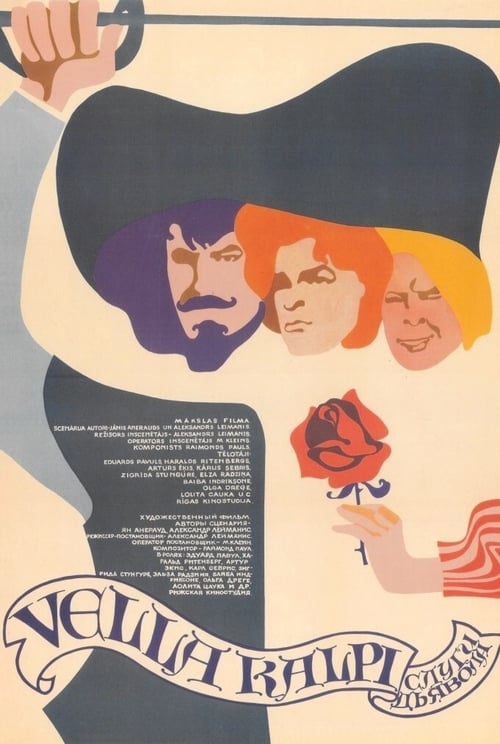
Devil's Servants
Plot
Three brave Latvian guys - Andris, Peter and Ermanis - justice, friendship and love for the totally inconceivable daring feats. For the feats they fall under, because opponent side is the power and the power, the court, and sometimes your opponent is not allowed for the mind and the quickness ... Brave young men spend their energy demand, enhance and support the three maidens, who love them and that they love: Ruta, Anna and Leene, like a brave and smart, funny and witty. There is no enemy that can stand against these six - for their joint efforts and together put in mind.
Get the Weekly Woke Watchlist
New and trending movies scored for woke bias, preachy messaging, and forced political themes — before you waste your evening.
No spam. One useful email per week.
Overall Series Review
Categorical Breakdown
The film’s central conflict is a nationalistic one, celebrating the courage and ingenuity of three working-class Latvian heroes who fight a foreign army (Swedes) and a corrupt local ruling class of nobles and burghers. Character worth is judged by loyalty, bravery, and cunning, which aligns with universal meritocracy, not an intersectional hierarchy. The focus on local Latvian heroes is an act of national pride, not a vilification of whiteness or a forced insertion of diversity.
The entire plot revolves around defending the home city of Riga from foreign domination, directly celebrating national and cultural heritage. The protagonists’ motivation is national pride and loyalty, traits celebrated as uniquely Latvian. The narrative explicitly views home and nation as a virtue worth fighting for against chaos and foreign invaders. This is the opposite of civilizational self-hatred.
The three female characters—Rūta, Anna, and Lēne—are portrayed as brave, smart, funny, and witty partners who actively support their male counterparts. One female character, Rūta, is specifically shown using her cunning to free the men from captivity. Their roles are clearly complementary to the men, and the story’s conclusion is a triple marriage, explicitly celebrating traditional pair-bonding and family as the reward for their joint efforts, which counters anti-natalist and 'Girl Boss' messaging.
The narrative centers entirely on three traditional male-female pairings whose romantic arcs are central to the story and are celebrated in the film's conclusion with a marriage ceremony. There is no presence of alternative sexualities, deconstruction of the nuclear family, or lecturing on gender theory.
The film features a villainous character who is a Lutheran Pastor (Pastor Samsons) and is part of the corrupt establishment willing to betray the city, suggesting a critique of clerical hypocrisy and corrupt religious power. However, the film ends with the Pastor presiding over the protagonists’ wedding, acknowledging the institution of the church and a transcendent moral law (justice, loyalty, love) as the driving force for the heroes, rather than embracing moral relativism.
Get the Weekly Woke Watchlist
New and trending movies scored for woke bias, preachy messaging, and forced political themes — before you waste your evening.
No spam. One useful email per week.