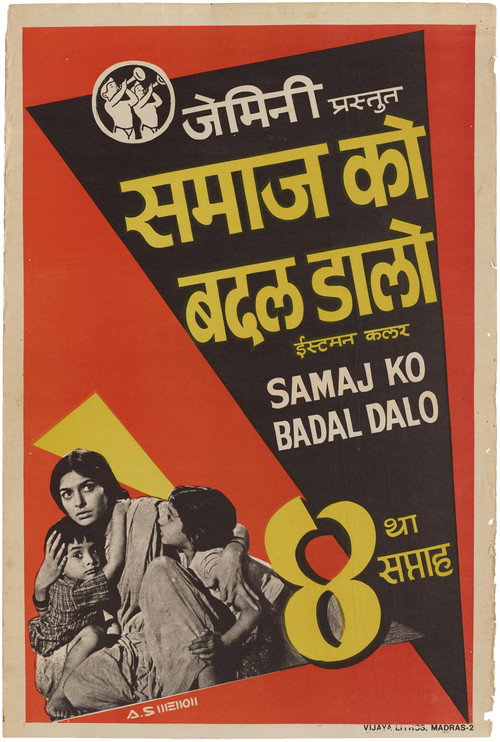
Samaj Ko Badal Dalo
Plot
Two close friends, Vimla and Chhaya, part ways when their friendship turns bitter. Years later, when Chhaya is arrested for a crime, Vimla, a lawyer, faces a moral dilemma.
Get the Weekly Woke Watchlist
New and trending movies scored for woke bias, preachy messaging, and forced political themes — before you waste your evening.
No spam. One useful email per week.
Overall Series Review
Categorical Breakdown
The central conflict revolves around class and economic struggle, depicting a straightforward battle between poor workers and wealthy, ruthless mill owners. The narrative focuses on poverty and exploitation, not on race or immutable characteristics as a primary source of oppression. Characters are judged by their actions as exploiters or honest laborers. The primary lens is socio-economic class, which functions as a universal theme of justice versus greed, placing it far from the modern intersectional hierarchy.
The film’s title, 'Change the Society,' is a critique of the extant *socio-economic* system and the rampant injustice and poverty it allows. The narrative argues for a reform of corrupt practices, particularly greed and labor exploitation, by the wealthy, rather than advocating a fundamental hatred or deconstruction of Indian civilization, family, or national heritage. Institutions are viewed as corrupted by capital, not inherently flawed in their nature.
Gender roles are complex and moderately progressive for the era. The protagonist, Chhaya, is a woman driven to extreme measures by her status as an honest person and a struggling single mother. Her former friend, Vimla, is presented as a highly capable professional woman holding the powerful position of Public Prosecutor. The focus on female characters in powerful roles is present, but the narrative does not universally emasculate male characters, who are defined by their moral compass (honest workers versus greedy capitalists). Motherhood is shown as a demanding, struggling state that drives the plot, not as a 'prison.'
The narrative is entirely focused on a social drama concerning poverty, class struggle, crime, and justice. The themes of alternative sexualities, gender ideology, or deconstruction of the nuclear family are absent. The film adheres to a normative social structure without incorporating or lecturing on queer theory.
The core evil in the film is human greed and the resultant socio-economic injustice inflicted by the wealthy on the poor. The narrative is focused on a call for objective moral justice and social reform, implying a higher moral law that is being violated by corrupt men. There is no depiction of traditional religion as the root of the problem, nor are religious figures or faith shown as bigoted or evil.
Get the Weekly Woke Watchlist
New and trending movies scored for woke bias, preachy messaging, and forced political themes — before you waste your evening.
No spam. One useful email per week.