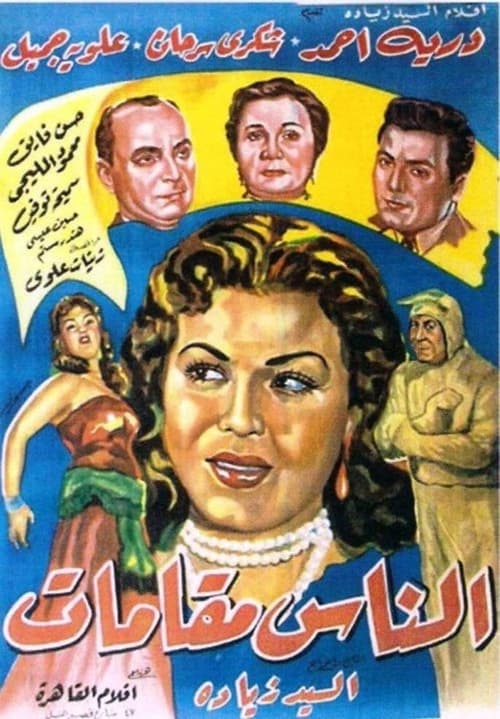
El naas makamat
Plot
Riyad Pasha frequents a gambling den run by an outlaw with his family. In this den, the Pasha loses a lot of his money. The villain's daughter tries to ensnare the police officer, the Pasha's son, to get his money.
Get the Weekly Woke Watchlist
New and trending movies scored for woke bias, preachy messaging, and forced political themes — before you waste your evening.
No spam. One useful email per week.
Overall Series Review
Categorical Breakdown
The film’s central theme is 'Class Distinctions,' focusing on a conflict between the elite (Pasha) and a criminal underclass (outlaw). The narrative judges characters based on their moral behavior (gambling, crime) and status, not on immutable characteristics or modern intersectional hierarchy. Diversity insertion is irrelevant as it is an Egyptian film about Egyptian society.
The critique is aimed at internal moral failings within Egyptian society—specifically the vice of the corrupt elite and the existence of a criminal underworld. This is a traditional internal social critique, not hostility toward its own culture or ancestors. It treats core institutions like the police (Pasha's son) as necessary shields against chaos.
The female lead is depicted as an ensnaring and manipulative character who uses her attraction to gain money from the male police officer. This depiction directly contradicts the 'Girl Boss' or 'perfect instantly' Mary Sue trope. It adheres to a traditional gender dynamic where femininity is used in a dangerous, non-idealized manner, though it does not celebrate motherhood.
The plot is entirely focused on a traditional male-female pairing in a seduction/entrapment dynamic. As a 1954 Egyptian film, it maintains a normative structure where sexuality is private and does not center alternative sexualities, deconstruct the nuclear family, or engage with gender ideology.
The conflict between crime, vice (gambling), and law suggests a clear, objective moral framework where one side is right and the other is wrong. This inherent moral structure acknowledges a higher moral law. There is no indication of hostility toward religion or promotion of moral relativism.
Get the Weekly Woke Watchlist
New and trending movies scored for woke bias, preachy messaging, and forced political themes — before you waste your evening.
No spam. One useful email per week.