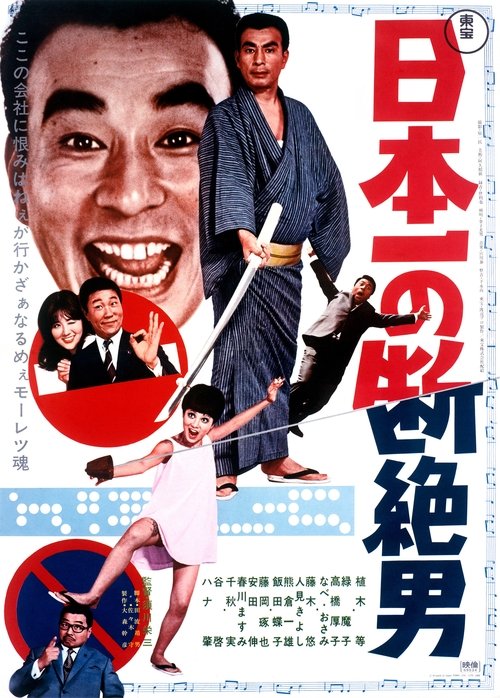
Japan's No. 1 Disconnected Man
Plot
Maruyama, a day laborer, is living on an abandoned ship at the port of Osaka when he meets an elusive man offering a job.
Get the Weekly Woke Watchlist
New and trending movies scored for woke bias, preachy messaging, and forced political themes — before you waste your evening.
No spam. One useful email per week.
Overall Series Review
Categorical Breakdown
The film is a Japanese-made comedy from 1969, featuring a Japanese cast and focusing on Japanese social class dynamics (day laborer versus the elite). The conflict is based on character status and merit within the Japanese system. There is no presence of anti-whiteness, racial hierarchy lectures, or forced diversity, as the narrative is culturally homogeneous and pre-dates the rise of intersectional identity politics.
The protagonist's moniker, 'Disconnected Man,' suggests an internal satire of Japanese post-war society and the soulless nature of the 'salaryman' corporate culture. This critique is directed at a specific economic and social system in Japan's modern history, not a wholesale demonization of the national civilization, culture, or ancestors. The film critiques the *system* of conformism rather than framing the home culture as fundamentally corrupt or morally inferior to an external culture.
As a mainstream 1969 Japanese comedy, the movie may contain traditional gender roles or sexual humor common to its era. However, there is no evidence of a modern 'Girl Boss' or 'Mary Sue' archetype. The plot centers on a male protagonist's career pursuit and social adjustment, and the themes of emasculation or anti-natalism are not central to the narrative, thus remaining within the realm of normative structure for its time.
Produced in 1969, the film's context and genre (mainstream Japanese comedy) do not support the presence of modern queer theory, gender ideology, or a storyline centering on alternative sexualities. The focus on the 'disconnected man' and his career path keeps the narrative within a strictly normative and private structure regarding sexuality and family.
The core conflict revolves around a day laborer's job and social integration in Osaka. The plot is focused on economic satire and social commentary, leaving no space for any substantial or antagonistic treatment of religion, especially Christianity. Morality is implicitly tied to societal values rather than being deconstructed as subjective 'power dynamics.'
Get the Weekly Woke Watchlist
New and trending movies scored for woke bias, preachy messaging, and forced political themes — before you waste your evening.
No spam. One useful email per week.