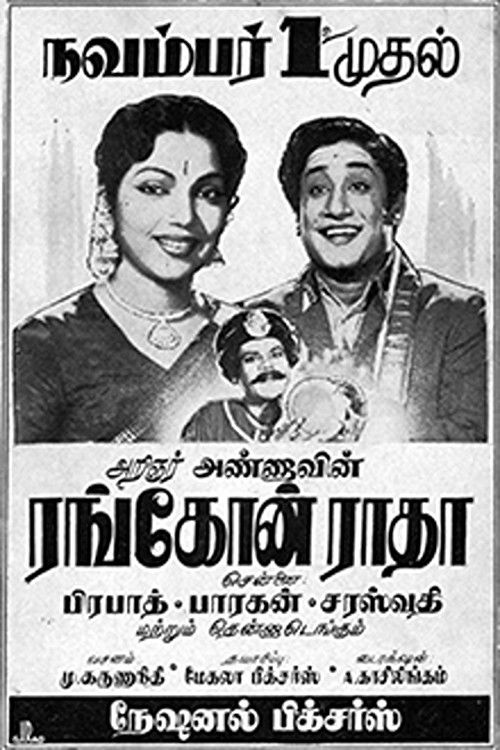
Rangoon Radha
Plot
Rangoon Radha, Sivaji Ganesan plays a rich hypocrite, a wolf in sheep’s clothing, married to a loving, dutiful wife (Bhanumathi). He covets his sister-in-law (Rajam) and manipulates his wife’s mind to make her believe that she is going insane. Instead of seeking medical advice, he gets a witch doctor to exorcise the evil spirit that is believed to possess her. Because of her undying love for her husband, she suffers all the torture, mental and physical, and even puts up with his marrying her sister (Rajam).
Get the Weekly Woke Watchlist
New and trending movies scored for woke bias, preachy messaging, and forced political themes — before you waste your evening.
No spam. One useful email per week.
Overall Series Review
Categorical Breakdown
Character motivation is entirely based on the rich man’s individual greed and lust versus his wife's virtue. The narrative makes no reference to immutable characteristics, race, or an intersectional hierarchy. The struggle is one of universal morality where a cunning scoundrel is vilified based solely on his evil deeds, not his identity group.
The film’s setting and cultural context are non-Western. The narrative is a critique of individual hypocrisy and criminal actions within a traditional family and society. It does not frame the home culture or its institutions as fundamentally corrupt or racist, but rather shows the victory of virtue over a corrupt individual, confirming core community values.
The female lead is portrayed as a virtuous, traditional, long-suffering wife whose primary characteristic is her 'undying love for her husband.' The male lead is a powerful, cunning villain who is neither emasculated nor bumbling. The narrative celebrates the wife's endurance and devotion, rather than promoting careerism, anti-natalism, or the 'Girl Boss' trope. The plot exposes individual male toxicity without indicting masculinity as a whole.
The narrative centers entirely on a heterosexual, albeit abusive, marriage and the villain's desire to replace his wife with her sister for financial and lustful motives. There is no presence of alternative sexual ideologies, deconstruction of the nuclear family, or focus on gender theory.
The villain attempts to exploit his wife’s perceived madness by hiring a witch doctor to perform an exorcism, which critiques the use of superstition and occult practices for manipulation. This points to a rationalist critique of specific folk beliefs and charlatanism rather than a direct hostility toward transcendent organized religion, and the final victory of the virtuous wife upholds an objective moral standard.
Get the Weekly Woke Watchlist
New and trending movies scored for woke bias, preachy messaging, and forced political themes — before you waste your evening.
No spam. One useful email per week.