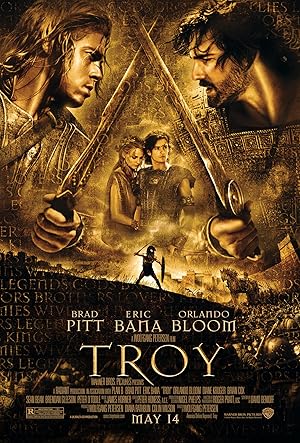
Troy
Plot
It is the year 1250 B.C. during the late Bronze age. Two emerging nations begin to clash after Paris, the Trojan prince, convinces Helen, Queen of Sparta, to leave her husband, Menelaus, and sail with him back to Troy. After Menelaus finds out that his wife was taken by the Trojans, he asks his brother Agamemnon to help him get her back. Agamemnon sees this as an opportunity for power. So they set off with 1,000 ships holding 50,000 Greeks to Troy. With the help of Achilles, the Greeks are able to fight the never before defeated Trojans. But they come to a stop by Hector, Prince of Troy. The whole movie shows their battle struggles and the foreshadowing of fate in this adaptation of Homer's classic "The Iliad."
Get the Weekly Woke Watchlist
New and trending movies scored for woke bias, preachy messaging, and forced political themes — before you waste your evening.
No spam. One useful email per week.
Overall Series Review
Categorical Breakdown
The movie follows a classical, meritocratic structure where characters are defined by their skill in battle or their moral honor. The casting aligns with the ancient Mediterranean setting, with no forced insertion of diversity or 'race-swapping' for the primary roles. The story centers on universal themes of war, fame, and personal choice, not on intersectional hierarchy or the vilification of a specific ethnic group.
The Greek leader, Agamemnon, is clearly the villain of the movie, driven by an insatiable hunger for conquest and power, which critiques the imperialistic nature of the Greek alliance. However, this is a critique of corrupt *leadership*, not a blanket demonization of the Western civilization's foundation. The Trojans, in contrast, are depicted as a noble people defending their home, and the best of the Greeks, like Achilles, oppose Agamemnon’s greed. This results in a balanced civilizational critique rather than full self-hatred.
The female characters operate within the patriarchal structure of the ancient world. They are not 'Girl Boss' figures with political power; they are primarily defined by their roles as queens, wives, and concubines. Hector’s masculinity is celebrated as protective and honorable, a figure who loves his wife and son. Achilles’s journey explicitly frames the choice between the glory of war (male fame) and a life of family (fatherhood), a classic epic theme that privileges the former but does not actively demonize motherhood as a prison.
The movie features a conservative sexual economy. The relationship between Achilles and Patroclus, which has historical and literary interpretations as romantic, is explicitly 'straightwashed' and re-framed as a bond between cousins and a mentor/mentee. All primary relationships in the film are strictly male-female, and there is no presence of alternative sexualities, deconstruction of the nuclear family, or lecturing on gender ideology.
The movie largely eliminates the active presence of the Greek gods, a major departure from the source text. Traditional religion is explicitly portrayed as a source of strategic weakness: King Priam ignores the sound military advice of his son Hector in favor of a priest's interpretation of a religious omen, which directly leads to the fall of Troy and the death of Hector. This narrative choice frames objective human logic and military strategy as superior to faith-based decision-making, presenting traditional belief as a cause of catastrophic failure.
Get the Weekly Woke Watchlist
New and trending movies scored for woke bias, preachy messaging, and forced political themes — before you waste your evening.
No spam. One useful email per week.