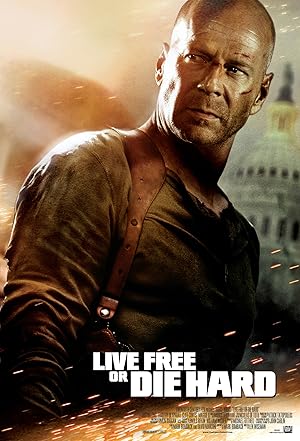
Live Free or Die Hard
Plot
When someone hacks into the computers at the FBI's Cyber Crime Division; the Director decides to round up all the hackers who could have done this. When he's told that because it's the 4th of July most of their agents are not around so they might have trouble getting people to get the hackers. So he instructs them to get local PD'S to take care of it. And one of the cops they ask is John McClane who is tasked with bringing a hacker named Farrell to the FBI. But as soon as he gets there someone starts shooting at them. McClane manages to get them out but they're still being pursued. And it's just when McClane arrives in Washington that the whole system breaks down and chaos ensues.
Get the Weekly Woke Watchlist
New and trending movies scored for woke bias, preachy messaging, and forced political themes — before you waste your evening.
No spam. One useful email per week.
Overall Series Review
Categorical Breakdown
The conflict operates entirely on a universal meritocracy of competence, pitting the hero's physical skill against the antagonist's technical skill. Characters of different races fill roles as hero, sidekick, supporting government official, and villain without any commentary on privilege or systemic oppression. The primary characters are judged solely by their actions and contribution to the plot.
The plot is a direct defense of America's national infrastructure against a coordinated cyber-attack by a domestic terrorist. The narrative frames core Western institutions and the American nation as objects to be protected from a cynical threat that seeks to sow chaos and profit from the destruction of society. There is no civilizational self-hatred or demonization of the West.
The core emotional stake revolves around the paternal relationship, with the protective masculine role of John McClane being the central theme. The primary female operative, Mai Linh, is a capable villain but is also sexualized and defeated by the male hero. The hero's daughter, Lucy, starts in a position of rebellion and is ultimately placed in the damsel role to be rescued, underscoring the importance of the family unit, which runs counter to the 'Girl Boss' and anti-natalism tropes.
The film does not contain any explicit sexual ideology or LGBTQ+ characters. All romantic and familial structures presented are normative, centering on the estranged male-female pairing of John and his wife (off-screen, implied) and the nuclear father-daughter bond with Lucy. The sexuality present is heteronormative and peripheral to the plot.
The movie is entirely secular, focusing only on the immediate, material conflict of stopping a cyber-attack. It is spiritually neutral rather than actively hostile, and does not engage with religion or offer an objective moral law, operating purely on a heroic, pragmatic sense of duty. This lack of any spiritual depth creates a moral vacuum, but there is no specific anti-Christian vilification.
Get the Weekly Woke Watchlist
New and trending movies scored for woke bias, preachy messaging, and forced political themes — before you waste your evening.
No spam. One useful email per week.