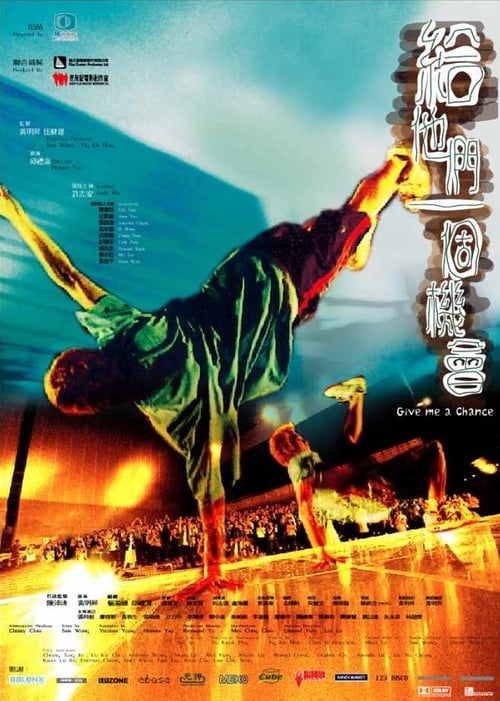
Give Them a Chance
Plot
Back in 2001, action director Sam Wong Ming-Sing shepherded a young group of lower-class dancers into the semi-big leagues. Thanks to great effort and timely sponsorship, the troupe was able to display their hip-hop street dance stylings as back-up dancers in Andy Lau's summer concert.
Get the Weekly Woke Watchlist
New and trending movies scored for woke bias, preachy messaging, and forced political themes — before you waste your evening.
No spam. One useful email per week.
Overall Series Review
Categorical Breakdown
The story's conflict centers on class struggle and personal hardship (low-class status, family problems, physical ailments), not on race or intersectional hierarchy. Character success is achieved through genuine talent and 'great effort' from the individuals, aligning with a principle of universal meritocracy. The narrative does not vilify any specific demographic and is not concerned with 'whiteness' or forced diversity.
The film is based in Hong Kong and appears to celebrate the ability of local youth to rise above their difficulties within their own community through art and determination. Institutions like family, though depicted as 'broken' for some characters, are a key source of personal drama and motivation, not a target for wholesale deconstruction. There is no evidence of civilizational self-hatred or a 'Noble Savage' trope.
The main plot is framed around a male mentor leading 'brothers' and young men (the Chinese title translates to 'Three Pairs of Brothers'), placing masculinity and brotherhood at the center. The significant female character acts as a lifelong friend, protector, and romantic interest, showing agency in her romantic choices, but the narrative does not foreground a 'Girl Boss' or 'Mary Sue' trope. The movie does not contain explicit anti-family or anti-natalist messaging.
The plot focuses on traditional family dynamics, including brother-brother and romantic conflicts. The story operates entirely within a normative structure, centering on male-female relationships and the nuclear/extended family unit, even a broken one. There is no inclusion of or lecturing on alternative sexual or gender ideologies.
The moral compass of the film is built upon values like perseverance, effort, and mentorship leading to a better life, which points to a belief in objective truth found through hard work. There is no discernible hostility toward religion, and faith or traditional morality is not presented as the root of evil or bigotry; rather, personal vice (such as involvement with triads) is the negative force.
Get the Weekly Woke Watchlist
New and trending movies scored for woke bias, preachy messaging, and forced political themes — before you waste your evening.
No spam. One useful email per week.