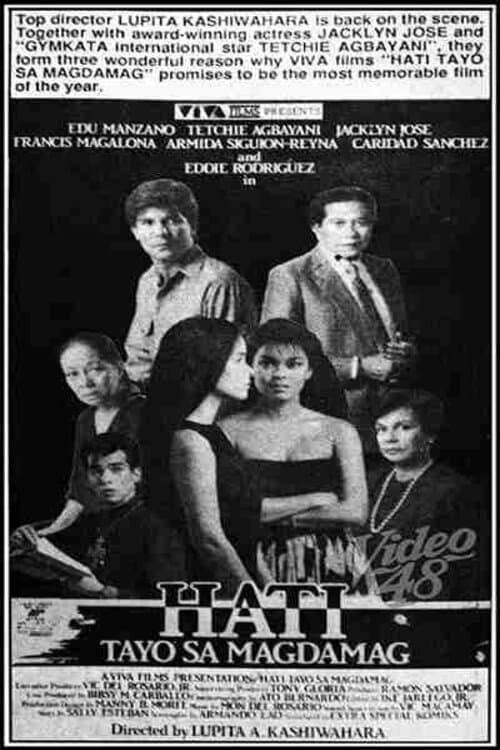
Hati Tayo Sa Magdamag
Plot
Gerry and Rochelle are childhood sweethearts. Although Rochelle wants to settle down, Gerry wants his ambitions fulfilled first. The couple's relationship is threatened by the arrival of their childhood friend Tonette. Tonette seduces Gerry away from Rochelle by giving him a job, an apartment and herself. She agrees to share him with Rochelle at the same time hiring Rochelle as a maid. Things soon come to a head when Rochelle decides to leave Tonette's household after repeated attempts by Tonette's father, Don Teofilo, to defile her.
Get the Weekly Woke Watchlist
New and trending movies scored for woke bias, preachy messaging, and forced political themes — before you waste your evening.
No spam. One useful email per week.
Overall Series Review
Categorical Breakdown
Characters are judged by their ambition and moral integrity, not by race or immutable characteristics. The primary conflict involves social class dynamics, contrasting the humble Rochelle with the wealthy Tonette, but this does not rely on an intersectional hierarchy or vilification of a specific identity group. All characters are of the same ethnicity.
The film is a domestic drama centered on personal relationships and social class issues within the Philippines. The narrative does not contain hostility toward Filipino culture, its ancestors, or Western civilization. Institutions of family and morality are presented as the structures Rochelle defends against the chaos of infidelity and corruption.
Tonette is a female character who uses her wealth and power to dominate a man and degrade her rival. She represents a powerful, transactional ‘Girl Boss’ figure, but the narrative frames her as the clear antagonist and source of the plot's moral decay. Rochelle, who desires a settled family life and eventually leaves the corrupt situation, is the moral heroine, reinforcing a valorization of traditional values and complementarian self-respect over female dominance and control.
The narrative focuses entirely on a traditional heterosexual love triangle involving Gerry, Rochelle, and Tonette. The film does not center alternative sexualities, deconstruct the nuclear family as a concept, or lecture on gender ideology. The structure remains strictly normative.
Religious themes are absent from the central conflict. The story is a secular morality tale where infidelity, manipulation, and sexual harassment are treated as objective wrongs that corrupt the characters and must be escaped. The moral framework is objective and transcendent, not subjective or based on 'power dynamics.'
Get the Weekly Woke Watchlist
New and trending movies scored for woke bias, preachy messaging, and forced political themes — before you waste your evening.
No spam. One useful email per week.