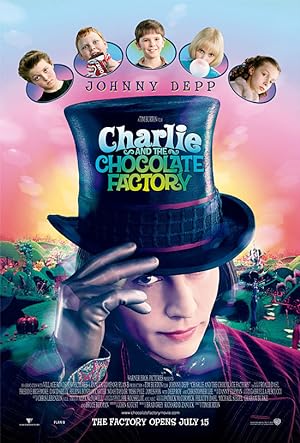
Charlie and the Chocolate Factory
Plot
When Willy Wonka decides to let five children into his chocolate factory, he decides to release five golden tickets in five separate chocolate bars, causing complete mayhem. The tickets start to be found, with the fifth going to a very special boy, called Charlie Bucket. With his Grandpa, Charlie joins the rest of the children to experience the most amazing factory ever. But not everything goes to plan within the factory.
Get the Weekly Woke Watchlist
New and trending movies scored for woke bias, preachy messaging, and forced political themes — before you waste your evening.
No spam. One useful email per week.
Overall Series Review
Categorical Breakdown
Characters are judged solely on moral merit, with all five children displaying universal virtues or vices such as greed and humility. The winner is the poor, humble character, which is a critique of class excess, not 'whiteness' or immutable characteristics. Casting is naturally diverse in terms of nationality but not forced based on an intersectional hierarchy. The only complexity arises from the Oompa-Loompas' backstory, which has been critiqued by some as an allegory for colonial paternalism, but the narrative itself focuses on character merit.
The film does not promote civilizational self-hatred. It critiques the excessive consumerism and poor parenting prevalent among the wealthy families. The hero’s home culture—a loving, multi-generational family unit enduring poverty—is celebrated as the highest good, an institution that acts as a shield against chaos. The critique is of *excessive wealth and modern vice*, not of the foundational principles of Western civilization or heritage.
Gender is complementary, not antagonistic. The mothers of the spoiled children are enablers of their children's vices, while Charlie’s mother is a source of strength and comfort. The female child characters (Violet, Veruca) are equally prone to moral failure as the male children (Augustus, Mike). The narrative's central message is the affirmation of motherhood and the traditional family unit as the source of human flourishing, contrasting directly with the 'career-only' and 'anti-natalism' messages.
The movie does not contain any representation of queer theory or alternative sexualities. The focus on the strong, loving, nuclear/extended family of the Buckets establishes the normative structure as the story's moral compass and ultimate prize.
The movie operates on a system of clear, objective, transcendent morality that punishes specific vices (gluttony, greed, pride, sloth) and rewards virtues (honesty, humility, love of family). The moral framework is explicitly didactic, promoting a higher moral law in direct opposition to moral relativism.
Get the Weekly Woke Watchlist
New and trending movies scored for woke bias, preachy messaging, and forced political themes — before you waste your evening.
No spam. One useful email per week.