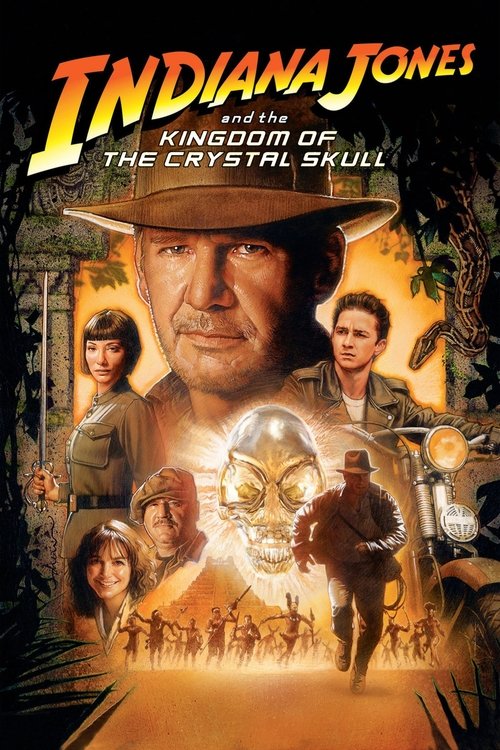
Indiana Jones and the Kingdom of the Crystal Skull
Plot
Set during the Cold War, the Soviets—led by sword-wielding Irina Spalko—are in search of a crystal skull which has supernatural powers related to a mystical Lost City of Gold. Indy is coerced to head to Peru at the behest of a young man whose friend—and Indy's colleague—Professor Oxley has been captured for his knowledge of the skull's whereabouts.
Get the Weekly Woke Watchlist
New and trending movies scored for woke bias, preachy messaging, and forced political themes — before you waste your evening.
No spam. One useful email per week.
Overall Series Review
Categorical Breakdown
Characters are judged by their actions, such as the Soviet antagonist's desire for mind control and Mac’s betrayal motivated by money. The story does not feature race-swapping or rely on intersectional hierarchy to drive the plot. The hero, Indiana Jones, is a competent white male, and his apprentice, Mutt Williams, is also a white male. The conflict is primarily geopolitical (US vs. Soviets) and based on individual moral choice (greed vs. integrity). The suggestion that ancient South American civilizations needed extraterrestrial assistance to build their cities presents a trope of a noble, yet dependent, savage, but this serves a science-fiction plot point rather than a modern identity politics critique.
The primary villains are Soviet communists, who represent a hostile foreign civilization, reinforcing a clear us-versus-them conflict typical of the Cold War setting. Indiana Jones is briefly targeted by his own college and government officials under suspicion of being a communist sympathizer, which critiques American institutional paranoia (McCarthyism) during that era. This critique introduces moral ambiguity regarding the home culture, but it is a specific political criticism of a historical period, not a broad demonization of the American civilizational heritage. The film concludes with Indiana Jones being reinstated, promoted, and marrying his long-time love interest, affirming the institutions of family and the nation.
The chief antagonist is Irina Spalko, a strong, intelligent, and formidable female Soviet agent who is capable of swordsmanship and command. She is defeated and destroyed by her own unchecked ambition for power, in a manner consistent with the hubris of the male villains in the earlier films. Marion Ravenwood is reintroduced as a self-sufficient woman and a mother. The narrative concludes with Indiana Jones and Marion marrying, which celebrates the traditional nuclear family unit. The film firmly establishes Indiana Jones's continuing status as the hero by having him take back his fedora at the end, preventing his son from symbolically replacing him.
The movie contains no discernible LGBTQ+ characters, themes, or messaging. The focus is exclusively on the heterosexual pairing of Indiana Jones and Marion Ravenwood and the revelation of their son. The narrative affirms the normative structure of the male-female pairing and the nuclear family as a source of strength for the hero.
The story departs from the use of Judeo-Christian holy relics like the Ark of the Covenant and the Holy Grail, instead centering the plot on a mystical crystal skull with a science-fiction origin involving interdimensional beings. This shift moves the transcendent morality away from Abrahamic faith and into an 'Ancient Aliens' spiritual vacuum. The film retains a core moral structure where the pursuit of power through the occult/mystical leads to the villain's destruction and the hero's survival, which acknowledges a higher moral law, but that law is not tied to traditional religion. Indiana Jones himself is shown to respect a pluralistic view of spiritual folklore.
Get the Weekly Woke Watchlist
New and trending movies scored for woke bias, preachy messaging, and forced political themes — before you waste your evening.
No spam. One useful email per week.