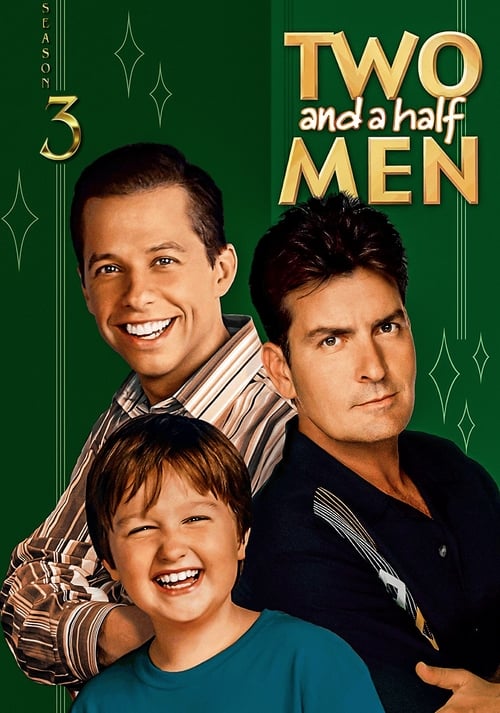
Two and a Half Men
Season 3 Analysis
Season Overview
Family ties tighten and tension rises as Charlie’s wild ways clash with Alan’s neuroses, leading to hilarious misadventures in love, work, and parenting.
Season Review
Categorical Breakdown
The narrative makes no use of race or immutable characteristics to determine character merit or to establish an intersectional hierarchy. Character flaws, such as Charlie’s womanizing or Alan’s incompetence, are personal, not systemic. The casting, while predominantly white, is authentically colorblind for the time, and the plot never stops to lecture on privilege or systemic oppression. This aligns with the universal meritocracy end of the scale.
The show does not vilify Western civilization as fundamentally corrupt or racist. Instead, it directs hostility inwards, consistently mocking the suburban/Malibu lifestyle, the institution of marriage (through Alan's disastrous ex-wife Judith and divorce payments), and the nuclear family model itself (with Alan and Jake living on Charlie's dime). The matriarch, Evelyn, is a 'maternally cold and domineering' figure, which deconstructs the traditional family unit through mockery, but this is a focus on the Harper family's dysfunction, not a broad attack on American heritage or institutions as 'racist' or 'colonial'.
Gender dynamics are defined by distinct, often stereotypical, roles. Alan, the primary male protagonist, is constantly emasculated by his ex-wife Judith and his mother Evelyn, who function as antagonistic forces and sources of financial and emotional punishment. Female characters like Kandi are portrayed as ditzy and high-maintenance, while others, like Judith and Evelyn, are depicted as 'shrews' or manipulative. There are no 'Girl Boss' or 'Mary Sue' leads, and career fulfillment is not a theme for the female characters. Mia's desire to use Charlie purely for sperm with no commitment leans toward anti-natalism, but it is framed as a character-specific eccentric demand, not a universal moral position.
Alternative sexualities are a minor feature, not a centered ideology. One episode title references the principal's lesbian lover, indicating the existence of non-normative relationships, but the humor is observational and shock-based, not an advocacy of queer theory or gender ideology directed at children. The entire structure of the show, revolving around Charlie's relentless pursuit of women, reinforces the traditional male-female pairing as the standard, even if highly dysfunctional and non-committal.
The core morality of the series is a subjective one where the characters prioritize pleasure, money, and self-interest, aligning with a moral relativism where higher moral law is ignored. One episode features a satirical storyline where Charlie dates a woman in a Satanist coven who tries to involve him in a ritual for cheap comedic effect. This treatment trivializes religious and spiritual concepts but does not engage in direct, serious vilification of Christianity or faith; it simply operates in a spiritual vacuum centered on base desires.