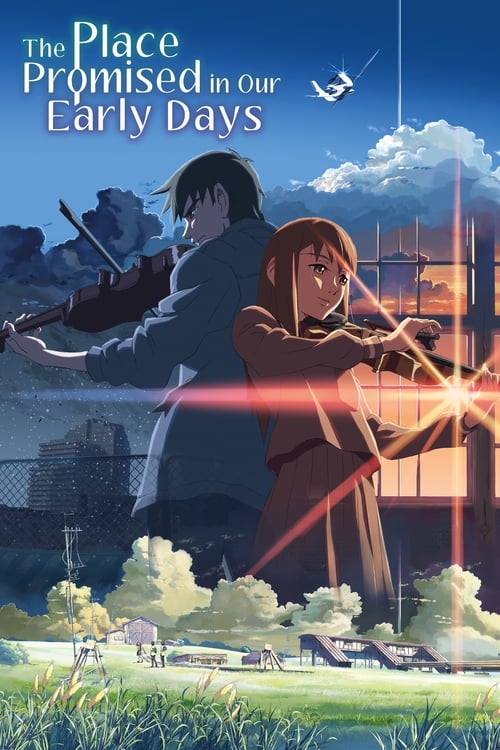
The Place Promised in Our Early Days
Plot
In a post-war alternative timeline, Japan is divided into the North, controlled by the Union, and the South, controlled by the United States. A mysterious high tower rises within the borders of the Union. Three high school students promise to cross the border with a self-built airplane and unravel the secret of the tower.
Get the Weekly Woke Watchlist
New and trending movies scored for woke bias, preachy messaging, and forced political themes — before you waste your evening.
No spam. One useful email per week.
Overall Series Review
Categorical Breakdown
Characters are judged by their engineering talent, ambition, and personal commitment to friendship and love, aligning with universal meritocracy. The protagonists are all of the same Japanese ethnicity. The geopolitical conflict is framed around national division (Japan vs. Soviet-aligned Ezo/Hokkaido) and political ideology (capitalism vs. communism), not race or intersectional hierarchy. There is no evidence of vilification of 'whiteness' or forced diversity.
The central political conflict is an alternate-history Cold War where Japan is divided into US-aligned and Soviet-aligned sectors. The main emotional drive is the pain of this division and the protagonists' dream to cross the border, which symbolizes a yearning for national unity and a refusal to accept the status quo of foreign control. The major threat, the mysterious tower, is built by the Union (Soviet-aligned state), and the narrative opposes the totalitarian-aligned state, which is not hostility toward the core Western values of the US-aligned side, but rather opposition to a totalitarian, opposing power.
Gender roles are traditional. The main drive of the plot is the two male protagonists, Hiroki and Takuya, who are skilled engineers, building a plane and taking risks to save Sayuri, who is in a coma. Sayuri functions as the 'damsel in distress' and the MacGuffin, as her condition is the key to the tower's existential threat. The male leads are depicted as competent and heroic; they are not bumbling idiots or emasculated. The narrative centers on a melancholy, heteronormative romantic longing.
The narrative focuses exclusively on the emotional and romantic connection between the three main characters, specifically the traditional male-female pairing. No presence of centering alternative sexualities, deconstructing the nuclear family, or lecturing on gender theory is detected. Sexuality remains a private aspect of the main characters' adolescent romantic journey.
The core of the story is scientific and romantic, involving quantum mechanics, parallel universes, and political intrigue, with no significant role for religious or theological themes. The moral struggle is existential (saving the world from a dimensional collapse) and personal (saving a friend), not one that critiques or demonizes traditional religion. The morality is objective in the sense of protecting one's world and friends, aligning with a higher moral law of compassion and duty.
Get the Weekly Woke Watchlist
New and trending movies scored for woke bias, preachy messaging, and forced political themes — before you waste your evening.
No spam. One useful email per week.