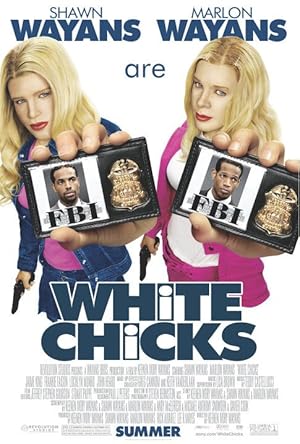
White Chicks
Plot
After an unsuccessful mission, FBI agents Kevin and Marcus Copeland fall into disgrace at the agency. They decide to work undercover on an abduction case disguised as Brittany and Tiffany Wilson, the vain, spoiled white daughters of a tycoon.
Get the Weekly Woke Watchlist
New and trending movies scored for woke bias, preachy messaging, and forced political themes — before you waste your evening.
No spam. One useful email per week.
Overall Series Review
Categorical Breakdown
The plot's central conceit is a reverse-race-swap, with two Black men donning 'whiteface' to perform as wealthy white women. The entire narrative functions as a broad satire of privilege and class, explicitly vilifying 'whiteness' as embodied by the spoiled, superficial, and often racist socialites the agents impersonate. Wealthy white males in positions of power, such as the actual villain, are depicted as predatory or corrupt. The movie's comedy directly lectures on racial and class stereotypes.
The film satirizes and demonizes a specific segment of American 'home culture'—the hyper-privileged elite and high society of the Hamptons—framing it as fundamentally corrupt, superficial, and morally bankrupt. Law enforcement institutions like the FBI are consistently portrayed as incompetent and bumbling, relying on the main characters' rule-breaking to solve the case.
The gender performance is temporary, a disguise for a case, which prevents a high score on the 'Girl Boss' metric. The male characters ultimately return to their heterosexual, male identities. Their brief immersion in female roles exposes the women they impersonate and their friends as obsessive over looks and men, making a comedic mockery of a superficial femininity rather than celebrating female empowerment. Masculinity is ultimately reaffirmed, even as one male protagonist gains emotional depth that benefits his traditional relationship with his wife.
The drag is a temporary, transactional disguise, with the plot's resolution reinforcing the characters' biological sex and heterosexuality. The film does not center alternative sexualities or deconstruct the nuclear family, as the main characters are motivated to save their careers and families. However, one minor, openly gay character is a flamboyant and exaggerated 'sissy' stereotype used almost exclusively for comedic effect.
The film contains no significant commentary or plot points related to religion, Christianity, or a spiritual vacuum. The focus is purely on secular themes of law enforcement, class, and race-based satire. The morality presented is a standard cinematic theme of good (FBI agents) versus evil (wealthy criminal) with no religious or anti-theist overtones.
Get the Weekly Woke Watchlist
New and trending movies scored for woke bias, preachy messaging, and forced political themes — before you waste your evening.
No spam. One useful email per week.