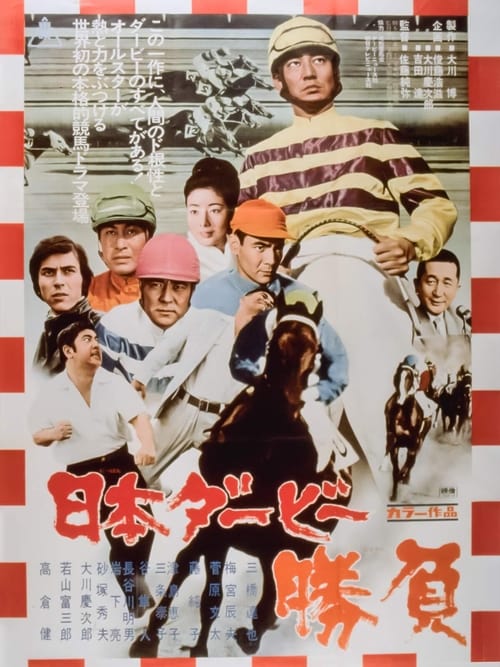
The Japan Derby Race
Plot
A story about a man who stakes his life on horse racing.
Get the Weekly Woke Watchlist
New and trending movies scored for woke bias, preachy messaging, and forced political themes — before you waste your evening.
No spam. One useful email per week.
Overall Series Review
Categorical Breakdown
The movie is a Japanese production focused on an internal Japanese struggle within the world of horse racing and gambling. The narrative concentrates on the protagonist's personal merit and fate in a high-stakes environment. There is no focus on immutable characteristics, intersectional hierarchy, vilification of 'whiteness,' or forced insertion of diversity, as the cast and setting are culturally and historically authentic to Japan.
The story is set in Japan and centers on a Japanese sporting event, the Japan Derby Race. The film explores a highly localized cultural scene and traditional drama tropes of high-stakes gambling and personal struggle. There is no evidence of hostility toward one's home or ancestors, nor is there a critique of Western civilization, making civilizational self-hatred irrelevant to the plot.
The main plot is defined as 'A story about a man who stakes his life on horse racing,' establishing a male-centric narrative. While prominent female actresses of the time might feature in roles of strength (e.g., as strong-willed partners or figures in the criminal underworld), these roles are typically contextualized within the complementary dynamics of the era's drama and yakuza genres. The narrative avoids modern 'Girl Boss' tropes, the emasculation of males as a thematic device, or anti-natalist messaging.
As a 1970 Japanese action-drama, the film adheres to the normative social structure of its time and culture. The focus is on traditional high-stakes drama and survival. There is no centering of alternative sexual ideologies, deconstruction of the nuclear family, or lecturing on gender theory. Sexuality remains private and is not the most important defining trait of any character.
The setting is secular drama focusing on the world of horse racing and gambling. The specific woke strain of anti-theism, which targets Christianity and promotes postmodern moral relativism as a critique of Western religion, is not applicable. The film does not contain hostility toward traditional religion, nor does it portray religious characters as villains or bigots. The moral framework is driven by the immediate consequences of gambling and personal choices, not a philosophical vacuum.
Get the Weekly Woke Watchlist
New and trending movies scored for woke bias, preachy messaging, and forced political themes — before you waste your evening.
No spam. One useful email per week.