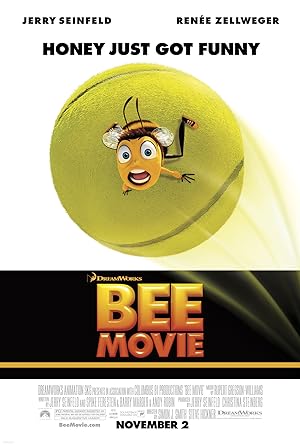
Bee Movie
Plot
When the bee Barry B. Benson (Jerry Seinfeld) graduates from college, he finds that he will have only one job for his entire life, and absolutely disappointed, he joins the team responsible for bringing the honey and pollination of the flowers to visit the world outside the hive. Once in Manhattan, he is saved by florist Vanessa Bloome (Renée Zellweger) and he breaks the bee law to thank Vanessa. They become friends and Barry discovers that humans exploit bees to sell the honey they produce. Barry decides to sue the human race, with destructive consequences to nature.
Get the Weekly Woke Watchlist
New and trending movies scored for woke bias, preachy messaging, and forced political themes — before you waste your evening.
No spam. One useful email per week.
Overall Series Review
Categorical Breakdown
The main conflict is between two species over labor rights and exploitation, entirely bypassing human racial or immutable characteristics. The narrative critiques exploitation, but this is a universal economic critique rather than a lecture on intersectional hierarchy or white privilege. Characters are judged by their actions in the lawsuit and their role in the ecological collapse, aligning with a meritocratic focus.
The protagonist rejects the rigid structure of his home (the hive) for the outside world, a common adventure trope. However, his lawsuit against the human system leads directly to a global ecological disaster—flowers die, and the bees lose their purpose. This outcome demonstrates the vital necessity of the established system (pollination/industry) and the danger of deconstruction, ultimately championing the home culture's essential function and respect for the natural order.
The main human female character is an independent florist. She is a supportive partner in the protagonist's quest and not a passive damsel. The male protagonist is the one driven by an existential crisis, and the minor male antagonist is depicted as somewhat jealous and bumbling. The narrative does not focus on the demonization of males or portray motherhood as a prison; the themes of family and natalism are absent due to the interspecies focus.
The core relationship is a non-traditional, interspecies pairing, but it is fundamentally heterosexual-coded. The film does not center alternative sexualities, nor does it contain explicit messaging deconstructing the nuclear family or promoting gender ideology. The focus remains on the legal and ecological consequences of the protagonist's actions.
The plot is entirely secular, revolving around legal, economic, and ecological issues. No characters are depicted as practicing religious faith. The film avoids hostility toward traditional religion. The resolution re-establishes the importance of an objective duty (pollination) necessary for the world's survival, which acknowledges a higher moral or natural law over simple subjective power dynamics.
Get the Weekly Woke Watchlist
New and trending movies scored for woke bias, preachy messaging, and forced political themes — before you waste your evening.
No spam. One useful email per week.