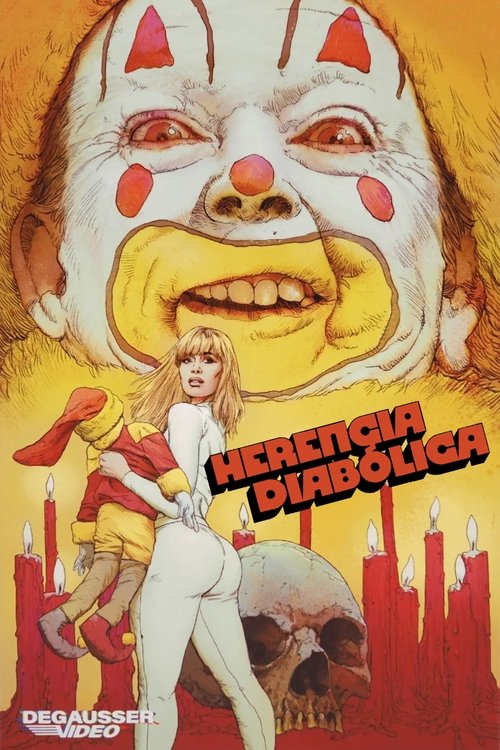
Diabolical Inheritance
Plot
When Tony, a successful businessman, receives a call informing him that he has inherited his late aunt's vast estate, he uproots himself and his wife, Annie, from New York to Mexico City. While adjusting to and exploring their new gothic home, Tony and Annie come upon a mysterious clown doll. Although merely unnerved by the doll’s strange appearance at first, Annie soon becomes concerned as it begins turning up out of nowhere in every corner of the house. When a series of fatal 'accidents’ occur on or near the couple’s property, with the doll always at the scene, Tony and Annie come to the terrifying realization that a sinister force has possessed it, and begin a race against time to figure out how to bring the carnage to an end!
Get the Weekly Woke Watchlist
New and trending movies scored for woke bias, preachy messaging, and forced political themes — before you waste your evening.
No spam. One useful email per week.
Overall Series Review
Categorical Breakdown
The core conflict revolves entirely around a demonic curse and spiritual possession. The narrative makes no effort to introduce social justice themes or to critique a specific racial or ethnic group. Character actions and motives are driven by the search for the malevolent entity, not by immutable characteristics or intersectional hierarchy.
The evil is tied directly to a specific family inheritance, a possessed object, and a creepy gothic house. The film frames this specific ancestral legacy as corrupt, which is a structural device necessary for the horror plot. The narrative does not broaden this specific curse into a condemnation of an entire civilization, nation, or culture.
The female character is the first to recognize the threat and express concern about the supernatural evil. This grants her a crucial intuitive role in the plot's early stages. The male lead is characterized by his initial skepticism and dismissal of the supernatural warnings. The dynamic serves a conventional horror trope where the woman is more spiritually or intuitively aware.
The central relationship is the traditional married pairing of a man and a woman. The plot contains no references to alternative sexual ideologies, gender theory, or commentary on the nuclear family structure. The film adheres to a normative structure.
The entire plot centers on a 'sinister force has possessed' the doll, making the film a story of objective, spiritual evil. The narrative establishes that powerful, transcendent morality and diabolical reality exist within the world of the film. The male character's secular skepticism towards the occult is portrayed as his primary failure, directly contrasting with moral relativism.
Get the Weekly Woke Watchlist
New and trending movies scored for woke bias, preachy messaging, and forced political themes — before you waste your evening.
No spam. One useful email per week.