American Dad!
Season 10 Analysis
Season Overview
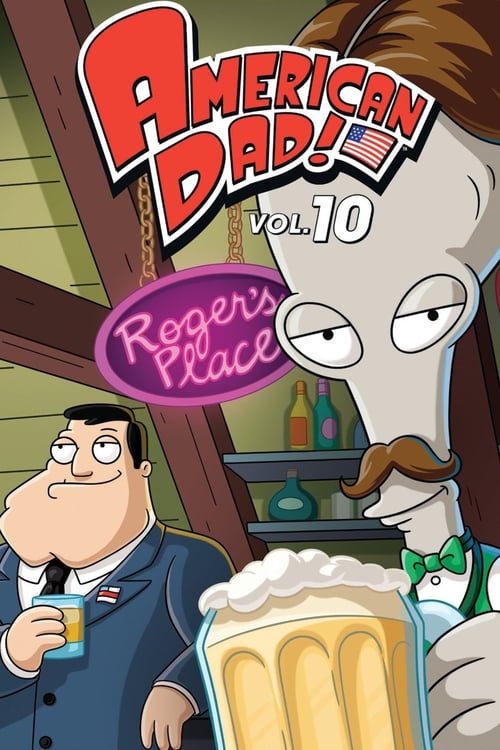
Belly-laugh up to the bar, folks… and satisfy your thirst for hilarity with the all-new collection of uncensored American Dad! episodes from the spirited minds of Mike Barker, Matt Weitzman and Family Guy creator Seth MacFarlane. Loaded with celebrity guest voices, including Mariah Carey, Terry Crews, Mark Cuban, Zooey Deschanel, Danny Glover and Olivia Wilde, this intoxicating assortment finds Stan fired from the CIA, Francine haunted by a sex-starved ghost, Steve kidnapped by a Christmas demon, and Roger and Klaus on a 100,000-mile road trip. Please watch responsibly.
Season Review
Categorical Breakdown
The narrative frequently satirizes white, conservative, and patriarchal figures, particularly Stan Smith, who is regularly depicted as an ignorant, inept, and deluded agent of the CIA, aligning with the vilification of 'whiteness' and the white male archetype. However, the show is an equal-opportunity offender, and characters of color or other identities are not automatically depicted as superior or purer. The satire is aimed at political and social incompetence regardless of race, which reduces the score from the top tier. Hayley's plot in 'Blonde Ambition' satirizes the privilege of conventional attractiveness.
Stan's obsessive, jingoistic 'patriotism' is the central joke of the series, framing American institutions like the CIA, national security, and conservative values as fundamentally absurd, chaotic, or corrupt. The episode 'Familyland' deconstructs the American ideal of the nuclear family and leisure through a disastrous theme park, whose founder is angry that the park failed to be a good influence on families. The overall worldview is one where the home and nation are sources of dysfunction and chaos, not a shield against it. The main 'wise' characters are a highly amoral alien (Roger) and a talking German fish (Klaus), who often drive the chaos, but are not 'Noble Savages' but rather sociopaths.
Francine is often defined by her role as a frustrated, underappreciated mother and wife who seeks fulfillment outside traditional norms, such as teaching Steve to shoplift or being haunted by the ghost of her own unsatisfied sex drive. Hayley, the liberal daughter, is a perpetually unproductive adult whose main character trait is leftist political rebellion and relationships. Men, Stan and Steve, are frequently incompetent and emasculated. The series leans heavily into gender dysfunction for comedy, but it does not present a consistent 'Girl Boss' trope or lecture on motherhood as a prison; instead, it presents a view of family life as a site of mutual, hysterical failure.
The score is high due to the explicit and uncritical engagement with gender ideology in the episode 'LGBSteve,' where Steve believes he is a 'female lesbian inside of a male body' and joins an all-girl rollerblading team. The plot centers alternative sexualities and gender identity as the primary character focus for the episode, framing the concept of gender identification as a natural, accepted part of modern life. This directly aligns with the 'Queer Theory Lens' by centering an alternative sexual/gender identity, although it is presented with a comedic sensibility rather than a heavy-handed lecture.
The show displays a general irreverence for established institutions, but direct hostility toward Christianity is low. The annual Christmas special, 'Minstrel Krampus,' avoids traditional religious themes by focusing on folklore and a demon, deconstructing the commercial holiday rather than the faith itself. The show's morality is consistently subjective, with characters adhering to self-serving or relative moral codes, aligning with a spiritual vacuum. There is no acknowledgment of 'Objective Truth' or 'higher moral law,' but also no plot that demonizes traditional religious practice.