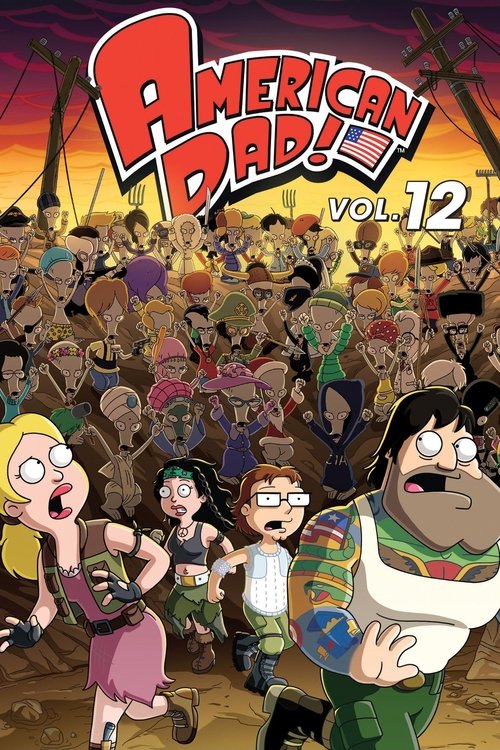
American Dad!
Season 12 Analysis
Season Overview
Get ready for full-scale hilarity and huge laughs with this all-new collection of American Dad! episodes from the comically oversized minds of Mike Barker, Matt Weitzman and Family Guy Creator Seth MacFarlane. Bulging with celebrity guest voices, including Kristin Chenoweth, Ted Danson, Kim Kardashian, Dean Norris, Mickey Rooney and Uma Thurman, this outrageous assortment finds Stan miniaturized after seeing a shrink, Steve embraces his inner lesbian, Roger crushing on a crash-landed alien , and the return of Jeff from space?.
Season Review
Categorical Breakdown
The narrative relies heavily on Stan's persona as an incompetent, often foolish white male authority figure for the core of the show's humor. Characters like Francine and Hayley are often seen as more astute or morally consistent in their main plots. Hayley's plot in 'Blonde Ambition' centers on her belief that changing her immutable characteristic (hair color) is required to be taken seriously in her activist endeavors. However, the season generally satirizes all characters equally for their flaws, which prevents the score from reaching the highest levels of vilification.
Hostility toward Western and American institutions, particularly the CIA, the suburbs, and the traditional family structure, is a consistent foundation of the show. The family is shielded not by their 'institution' but by their sheer absurdity and Stan's government job, often depicting the home as a dysfunctional place of chaos. Stan's political ideology, a stand-in for conservative American values, is constantly undermined by his idiocy. The show's satire targets the hypocrisies of the American system rather than celebrating its foundation.
Male characters are consistently portrayed as bumbling, insecure, or toxic, especially Stan, whose attempts to assert dominance or masculinity often end in disaster. Female characters, such as Francine, are often depicted as more cunning or level-headed than their male counterparts. Francine's plots occasionally frame her marriage to Stan as a frustration or a trap, such as when Stan commits her to a mental hospital simply for covering up a forgotten anniversary. The primary gender dynamic centers on the emasculation of Stan and the superior competence of his female peers, family, and rivals.
The score is very high due to the episode 'LGBSteve,' which directly centers on the deconstruction of gender and sexual identity. Steve joins an all-girls roller derby team, and his teammates conclude he must be a 'girl trapped in a boy's body.' When Steve realizes he still likes girls, the conclusion is drawn that he is a 'lesbian trapped inside a boy's body.' This plot centers on gender and sexual identity as the most important trait, using queer theory to re-frame biological reality and heterosexual attraction (liking girls) through the lens of identity (still being 'inside' a boy's body).
As an animated comedy, the show avoids a sustained focus on transcendent morality, preferring subjective plots and moral relativism in its characters' actions. The main character, Stan, is a Republican Christian, and his religious faith is routinely mocked, not for the faith itself, but for his hypocrisy and poor application of it. Traditional religion is not framed as the root of evil but as another vehicle for Stan's self-serving incompetence, keeping the score in the middle range of irreverent but not overtly anti-theistic.