American Dad!
Season 14 Analysis
Season Overview
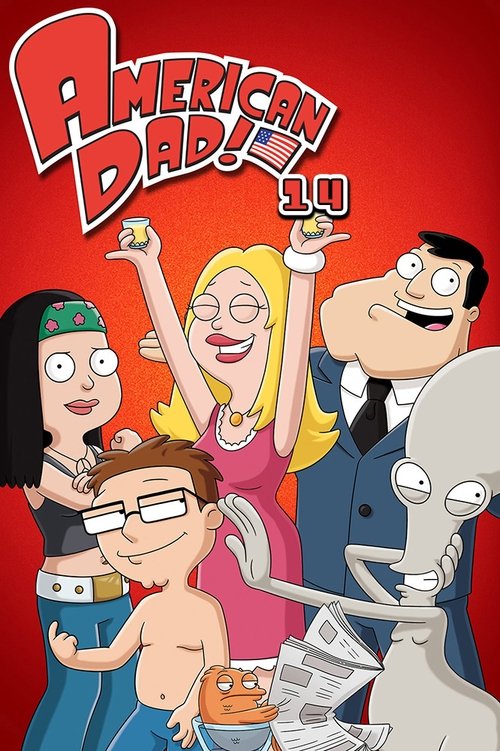
Celebrate the wit, wisdom and wild absurdity of your favorite all-American family with this all-new collection of American Dad! episodes. Crammed with celebrity guest voices, including Susan Sarandon, Jennifer Coolidge, Alfred Molina, Allison Janney and Danny Trejo, this sidesplitting assortment finds Stan shooting his mouth off in the Old West, Francine transformed into a sexy super-spy, Steve spellbound by a book of witchcraft, Jeff reborn as a full human, and Roger having a very fishy affair...with Klaus!
Season Review
Categorical Breakdown
The narrative does not center on race, privilege, or systemic oppression as a primary theme. Characters are not generally defined by immutable characteristics but by their extreme personality flaws and roles in absurd plots. Stan, a white male, is consistently depicted as incompetent, selfish, and wrong, but this is a long-running character trait for comedic effect, not a specific indictment of 'whiteness.' The plotlines are driven by individual character neuroses rather than a lecture on intersectional hierarchy.
The show treats core American institutions and heritage with consistent satirical disdain. Stan's CIA job, American holidays, and the nuclear family structure are routinely dismantled for comedy. The episode involving Francine's birth family portrays her ancestors not as noble, but as a pathologically dysfunctional group ready to engage in a violent competition over a phone plan. This deconstruction is primarily for comedic absurdity, stopping short of genuine civlizational self-hatred, viewing the home culture as ludicrous rather than fundamentally evil.
Francine is often presented as the pragmatic center of the family, but her competence is not absolute; she frequently makes poor decisions when trying to 'fix' her marriage or life. Stan is regularly emasculated, often bumbling or wrong, serving as a constant punchline to his wife and daughter. The plot involving Hayley and Jeff attempting to conceive introduces a momentary anti-natalist conflict, but this is quickly overtaken by a highly surreal and non-serious storyline about Jeff's re-humanization and Roger's mock-pregnancy, not a lecture on career-as-only-fulfillment.
Alternative sexual identity is strongly centered in the episode 'Kloger,' which focuses entirely on a secret, graphic affair between Roger (an alien) and Klaus (a German-speaking fish). Roger, an alien, embodies radical sexual fluidity, taking on a number of gendered and sexual personas, including pretending to be an escort in another episode. This narrative normalizes and places a highly non-traditional relationship at the core of a major episode plot, making sexual identity central to the comedy and character arc, completely outside of the nuclear family structure.
The season features direct mockery of organized religion and spiritual figures. The long-running 'Golden Turd' storyline culminates in its presentation to Pope Francis and a council of religious leaders, who are then incorporated into the ongoing, dark, and absurd saga. A Christmas episode portrays Santa Claus as an evil, manipulative figure who uses children for forced labor for an 'ancient ritual.' These plots specifically satirize and vilify traditional religious authority and belief systems, though the tone is more irreverent and absurd than philosophical.