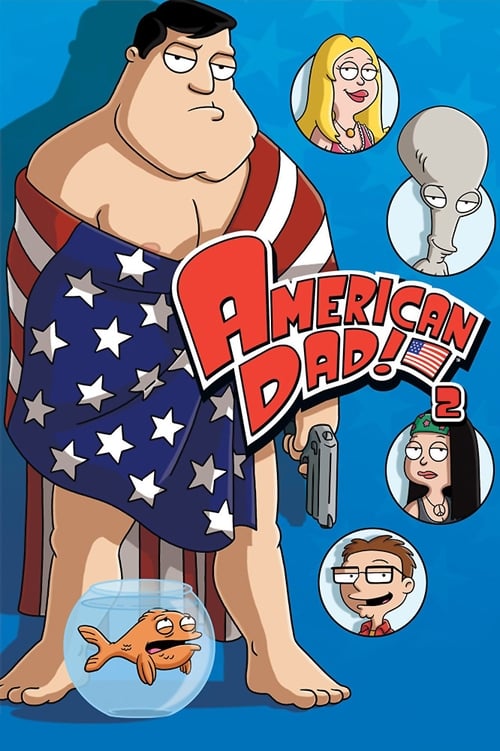
American Dad!
Season 2 Analysis
Season Overview
Terrorists (and all you bed-wetting hippie-liberal types) beware! Ultra-right-wing C.I.A. agent Stan Smith is back, taking names, and, well, you know the rest. Join Stan, along with his hilariously off-beat family, as he spans the globe to make the world safe for democracy! If you are ready to support your country, and if you're ready for a widly outrageous animated farce from Mike Barker, Matt Weitzman and Seth MacFarlane, the creative mastermind behind Family Guy, you're ready for American Dad! Volume two. God bless America.
Season Review
Categorical Breakdown
Stan's conservative patriotism is the constant punchline, with plotlines explicitly focusing on race, immigration, and foreign policy, portraying the main white male character as racist, paranoid, or incompetent in these matters. The episode 'American Dream Factory' frames Stan as an exploitative capitalist who uses illegal Mexican immigrants for cheap labor until his liberal daughter calls the authorities on him.
The central protagonist, Stan, is an exaggerated parody of jingoistic American culture and government institutions, particularly the CIA, which are consistently shown to be paranoid, misguided, and corrupt. The episode 'Bush Comes to Dinner' is a direct, prolonged satire and humiliation of the US President, depicting the figure of the ultimate American leader as a buffoon. This constant satirical attack on American institutions and heritage as fundamentally flawed aligns with a high self-hatred score.
Francine is frequently shown to be stifled and bored by her role as a housewife, desiring excitement or a career outside of her domestic prison, which is a common anti-family trope. Stan is repeatedly emasculated by his own incompetence, his son's geekiness, or by Francine's intelligence. Men are generally portrayed as bumbling, insecure, or toxic, but the narrative does not yet wholly adopt the 'Girl Boss' trope for Francine; it focuses more on marital discontent.
The episode 'Lincoln Lover' directly centers on the issue of sexual identity, with Stan trying to join a gay Republican group and initially believing being gay is a choice, only to learn and ultimately advocate that it is not a choice. This plot validates a progressive viewpoint on sexual orientation and elevates the visibility of a gay couple (Terry and Greg) in the community, moving the score higher due to the explicit political centering of the identity.
The episode 'The Best Christmas Story Never Told' centers on Stan's religious zealotry, which is presented as a warped, violent, and misinformed moral compass when he attempts to save Christmas by traveling back in time to commit murder. The narrative satirizes the Christian conservative's 'War on Christmas' mentality by showing it as a source of absurdity and moral bankruptcy, not as a source of transcendent morality.