American Dad!
Season 4 Analysis
Season Overview
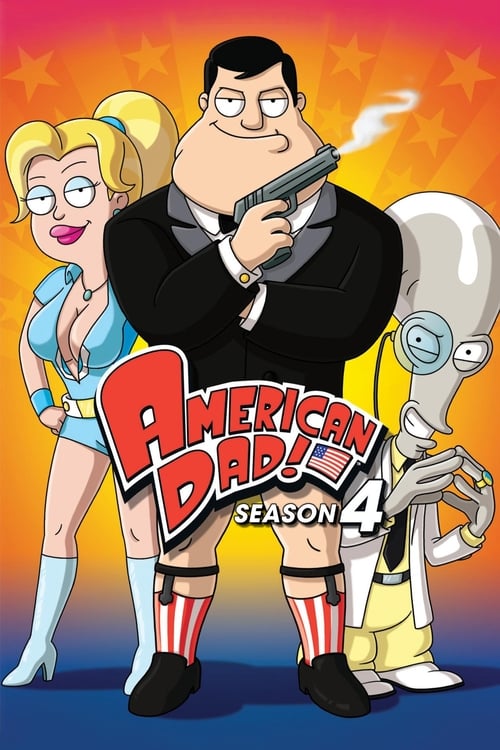
Attention, terrorists, pinkos, and hippies: your days are numbered! CIA Agent Stan Smith is back, stopping at nothing to make the world safe for right-wing democracy and provide for his outrageously dysfunctional extended family. Amid botched kidnappings and beefcake body doubles, Stan hosts a torturously funny CIA telethon; his wife, Francine, is reunited with her ex-fiance; and resident-alien Roger hosts a booze-soaked spring break that may just push favorite son Steve all the way through puberty. God bless American Dad!
Season Review
Categorical Breakdown
The narrative does not generally rely on intersectional hierarchy or immutable characteristics over character merit, though racial humor is present. Stan's conservative persona is the main source of satire, but he is consistently portrayed as an incompetent/foolish figure whose flaws are personal rather than purely due to 'whiteness.' An earlier episode (often included in this volume's run) features Stan's exploitation of illegal immigrants in his business venture, framing him as a bad actor due to greed, not as a lecture on systemic oppression. The comedy targets Stan's ignorance, not his identity as a white male, which keeps the score low, but the presence of politically charged themes prevents a 1/10 score.
Hostility is directed toward Stan’s specific brand of jingoistic, paranoid American culture, not Western civilization as a whole. The family institution, while dysfunctional, is still the center of their lives, operating as a shield against the chaos of the outside world. The show satirizes Stan's CIA job and U.S. government incompetence, but the central setting and premise are a celebration of the American animated sitcom, which respects the genre's institutions. The ancestors are not consistently demonized, though Stan's own father is an amoral con man, which serves a character-specific plot about Stan's trauma, not a deconstruction of heritage.
Francine is presented as a traditional housewife but is far from a weak or repressed female character; she is competent, physically capable in a fight (e.g., against Stan's backup wife), and often the voice of reason or the driver of her own plotlines. Stan is frequently depicted as a bumbling idiot, but his emasculation is a result of his own idiocy and emotional ineptitude (e.g., arranging 'Wife Insurance' behind Francine's back), which ultimately reaffirms his dependence on Francine. The show does not feature 'Girl Boss' tropes, but a B-plot where Roger and Hayley compete over attracting men for vanity is misogynistic and objectifying, though played for dark comedy, earning a moderate score.
Alternative sexualities are a normalized feature of the show's world, not a source of lecturing. The Smiths' gay neighbors, Greg and Terry, are recurring characters without their sexuality being their sole defining trait. The episode 'Daddy Queerest' centers on Stan and Francine pretending to be a gay couple to save Terry's coming-out, making alternative sexuality a key plot driver for comedy and conflict. Stan's earlier 'gay panic' is noted as having evolved into acceptance, showing character progression. This centers the subject but frames it as a source of absurd comedy without focusing on 'gender ideology' or vilifying the nuclear family, leading to a mid-level score.
Traditional religion is not a consistent focus, but when it appears, it is used for irreverent satire. An episode involves Stan praying to God for a friend, which is immediately undercut by God providing him with a radical atheist, and their relationship becoming a major plot point, demonstrating that faith is not presented as a clear source of strength. However, Christian characters are not consistently depicted as bigots or villains, and the overall moral fabric of the show is subjective chaos (neutral moral relativism) rather than a direct, aggressive hostility toward the divine, resulting in a low but not absent score.