American Dad!
Season 6 Analysis
Season Overview
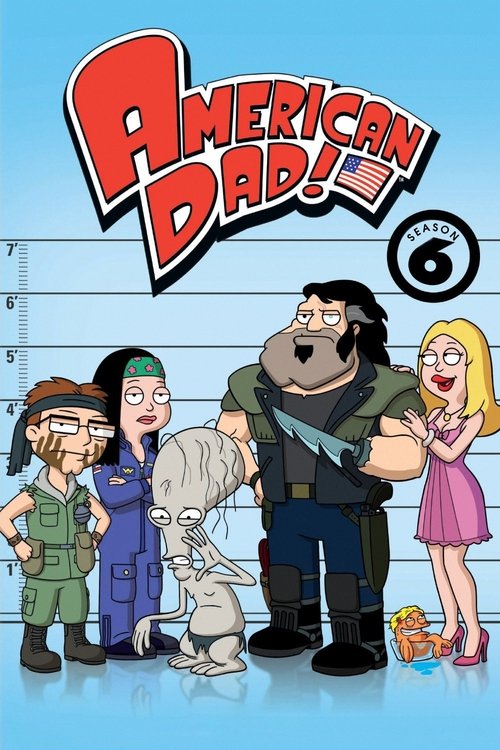
Trigger-happy CIA operative Stan Smith will stop at nothing to defend everything that makes this country great – from strip bars to that most sacred of American institutions, crack cocaine! Whether he's trading brains with a racehorse or rescuing Roger from bloodthirsty revolutionaries, Stan will do whatever it takes to secure the blessings of liberty in this over-the-top salute to the greatest nation on Earth.
Season Review
Categorical Breakdown
The narrative satire focuses on economic and political ideologies, such as Stan's conservative anti-welfare stance versus Hayley's liberal one, which is ultimately resolved with a nuanced 'both sides have a point' lesson, rather than focusing on intersectional privilege or race. There is no forced insertion of diversity or direct vilification of 'whiteness'; the white male lead is vilified for his self-serving incompetence and hypocrisy, which are character-driven flaws.
The central pillar of the show is the deconstruction of Western civilization and American institutions. Stan's unwavering patriotism is consistently shown to lead to hilariously misguided and sometimes cruel actions, such as accidentally killing a foreign dictator in 'Moon Over Isla Island' to exploit a nation for oil. The episode 'In Country...Club' ridicules the romanticization of military conflict by showing Stan's actions causing his son trauma, framing the home culture's pride as misplaced and often destructive.
Gender dynamics are satirical but not explicitly anti-natalist or 'Girl Boss' focused. The episode 'Shallow Vows' critiques the shallowness of Stan's male gaze but ultimately shows Francine is equally flawed when she struggles with the responsibility of caring for a blind Stan. The conflict is a moral failing within the marriage, concluding with the nuclear family unit intact, albeit in an absurd fashion.
Roger the alien is a permanent, central figure who is inherently gender-fluid and uses hundreds of different personas, including female ones (e.g., Jeanie Gold). This character is a continuous, visible subversion of a normative structure. However, the narratives center on comedy and plot device, not a political lecture on queer theory, and the nuclear family remains the standard societal structure being mocked.
The episode 'Rapture's Delight' is highly irreverent, showing a Rapture, a resurrected Jesus, and the Anti-Christ. The episode satirizes the hypocrisy of Stan's Christian faith—he is left behind for selfish acts—but it firmly establishes that a higher moral law and the Christian God's plan are objectively real within the world of the show. It is an attack on hypocritical practice, not a spiritual vacuum or denial of objective truth.