Tangled
Plot
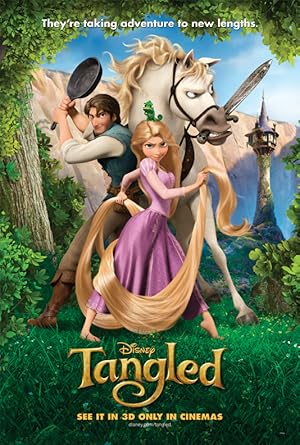
After receiving the healing powers from a magical flower, the baby Princess Rapunzel is kidnapped from the palace in the middle of the night by Mother Gothel. Mother Gothel knows that the flower's magical powers are now growing within the golden hair of Rapunzel, and to stay young, she must lock Rapunzel in her hidden tower. Rapunzel is now a teenager and her hair has grown to a length of 70-feet. The beautiful Rapunzel has been in the tower her entire life, and she is curious of the outside world. One day, the bandit Flynn Ryder scales the tower and is taken captive by Rapunzel. Rapunzel strikes a deal with the charming thief to act as her guide to travel to the place where the floating lights come from that she has seen every year on her birthday. Rapunzel is about to have the most exciting and magnificent journey of her life.
Get the Weekly Woke Watchlist
New and trending movies scored for woke bias, preachy messaging, and forced political themes — before you waste your evening.
No spam. One useful email per week.
Overall Series Review
Categorical Breakdown
Characters are judged purely by their actions, with the central conflict revolving around Mother Gothel’s vanity and kidnapping versus Rapunzel's virtuous quest and Flynn Rider’s moral reformation. There is no element of intersectional hierarchy, vilification of 'whiteness,' or forced insertion of diversity. The story operates on a universal meritocracy where character is defined by the content of their soul and choices.
The kingdom of Corona is consistently portrayed as a beautiful, thriving, and loving home that genuinely mourns its lost princess. The villain, Mother Gothel, attempts to instill hostility toward the world by framing it as corrupt and dangerous to keep Rapunzel isolated. The hero's goal is explicitly to embrace her home, ancestors (King and Queen), and civilization, directly contrasting the definition of civilizational self-hatred.
Rapunzel is an active protagonist who is competent, self-rescuing, and drives the plot, but she is not a 'Mary Sue' and is prone to emotional vulnerability and self-doubt. The male lead, Flynn Rider, is a capable thief who is redeemed by love and ultimately makes a self-sacrificing choice, demonstrating protective masculinity. The conclusion is a celebration of a male-female pairing and a return to the nuclear family/royal institution, contrasting an anti-natalist or anti-family message.
The core romance is a traditional male-female pairing that concludes with a proposal and marriage. The movie adheres to a normative structure without centering alternative sexualities, deconstructing the nuclear family, or including any lecturing on contemporary gender ideology.
The movie operates on a clear, objective moral framework where narcissistic selfishness (Mother Gothel) is evil, and self-sacrifice and love are good. The magical element is a 'drop of sun from the heavens,' which some interpretations link to positive Christian metaphors. The narrative contains no hostility, critique, or mention of organized religion.
Get the Weekly Woke Watchlist
New and trending movies scored for woke bias, preachy messaging, and forced political themes — before you waste your evening.
No spam. One useful email per week.