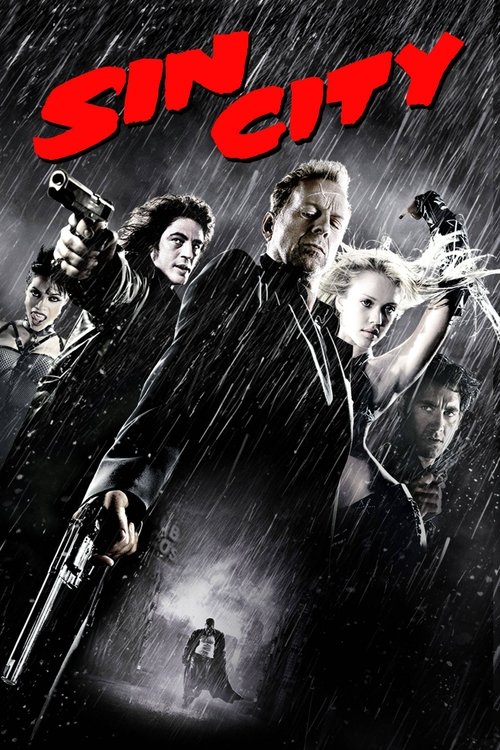
Sin City
Plot
Welcome to Sin City. This town beckons to the tough, the corrupt, the brokenhearted. Some call it dark… Hard-boiled. Then there are those who call it home — Crooked cops, sexy dames, desperate vigilantes. Some are seeking revenge, others lust after redemption, and then there are those hoping for a little of both. A universe of unlikely and reluctant heroes still trying to do the right thing in a city that refuses to care.
Get the Weekly Woke Watchlist
New and trending movies scored for woke bias, preachy messaging, and forced political themes — before you waste your evening.
No spam. One useful email per week.
Overall Series Review
Categorical Breakdown
Characters are universally judged by their individual corruption or their capacity for violence and personal honor, completely irrespective of race or immutable characteristics. The narrative is a colorblind exploration of vice, with the heroes and villains representing a wide range of ethnicities purely in the service of genre archetypes, not political commentary. All characters are defined by the content of their soul and their brutal actions.
The film displays extreme hostility toward the institutions of Basin City, framing its government, police, and elite as irredeemably corrupt. This is a nihilistic deconstruction of a fictional American urbanity, where institutions are shields for chaos rather than against it. The contempt is directed at the city's power structure and not a broad Western heritage or culture, aligning with the classic genre of noir fatalism rather than civilizational self-hatred.
Gender dynamics are the opposite of the 'Girl Boss' trope, rooted in a highly sexualized, exploitative, and traditional noir lens. Women are predominantly depicted as 'dames,' 'broads,' or 'whores'—either as damsels to be saved, manipulative femmes fatales, or hyper-sexualized, independent killers who exist primarily in relation to the brooding male protagonists. Masculinity is celebrated as a protective, vengeful force, which completely bypasses the anti-natalist and emasculation metrics.
The core of the intersecting stories is built upon highly transactional, often toxic, male-female pairings and the male-savior trope. There is no centering of alternative sexualities, no deconstruction of the nuclear family as an institution, and no lecturing on sexual or gender ideology. Sexuality, while abundant and dark, remains a private matter tied to the vice of the city, keeping the structure entirely normative.
A high-ranking religious official, Cardinal Roark, is revealed to be a central villain in the city's corruption, directly protecting a cannibalistic serial killer who is his relative. The narrative concludes with the violent, gruesome execution of this Cardinal by a protagonist, directly establishing the powerful figure of the traditional church as the ultimate source of systemic evil and depravity.
Get the Weekly Woke Watchlist
New and trending movies scored for woke bias, preachy messaging, and forced political themes — before you waste your evening.
No spam. One useful email per week.