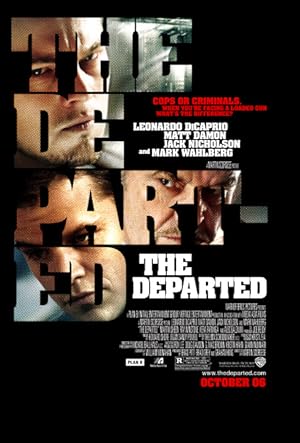
The Departed
Plot
In this crime-action tour de force, the South Boston state police force is waging war on Irish-American organized crime. Young undercover cop Billy Costigan is assigned to infiltrate the mob syndicate run by gangland chief Frank Costello. While Billy quickly gains Costello's confidence, Colin Sullivan, a hardened young criminal who has infiltrated the state police as an informer for the syndicate is rising to a position of power in the Special Investigation Unit. Each man becomes deeply consumed by their double lives, gathering information about the plans and counter-plans of the operations they have penetrated. But when it becomes clear to both the mob and the police that there is a mole in their midst, Billy and Colin are suddenly in danger of being caught and exposed to the enemy - and each must race to uncover the identity of the other man in time to save themselves. But is either willing to turn on their friends and comrades they've made during their long stints undercover?
Get the Weekly Woke Watchlist
New and trending movies scored for woke bias, preachy messaging, and forced political themes — before you waste your evening.
No spam. One useful email per week.
Overall Series Review
Categorical Breakdown
The film centers on a specific white ethnic group, Irish-Americans in Boston, and explores the crisis of identity within this community, not the politics of 'whiteness' or intersectional hierarchy. Protagonists are judged entirely by their choices and actions—becoming a cop or a criminal—which is a classic merit-based moral dilemma. The plot does not exist to lecture on systemic oppression, nor does it feature 'race-swapping' or forced diversity. The focus is on the character's internal corruption, which is colorblind to political ideology.
The institutions of 'home'—the local police force and the Irish-American community—are shown to be thoroughly corrupt, violent, and self-destructive. However, the critique is limited to the specific, criminalized Boston subculture. The film is not a broad-based attack on Western civilization, American heritage, or its ancestors generally. It is a bleak, localized portrait of institutional failure and a spiritual vacuum within a singular community, rather than a universal demonization of the home culture in favor of an idealized 'Other.'
The core story is a study in destructive masculinity, with women playing a minimal role. The female psychologist character, Madolyn Madden, is positioned as a dramatic foil and love interest to both main male protagonists. She is a professional, but her narrative function revolves around the men's emotional and sexual conflicts, and she is ultimately 'torn between two men.' The story has a 'monolithic, gendered power structure' and is devoid of 'Girl Boss' or overt anti-natalist messages. Masculinity is not celebrated as protective but is depicted as insecure and violent, but it is also not universally emasculated.
The narrative takes place in a hyper-masculine, traditional Boston subculture where homophobic slurs are used frequently. The film maintains a normative structure where the traditional male-female pairing is the only structure present. There is no centering of alternative sexualities, no deconstruction of the nuclear family, and no lecturing on gender theory. The world depicted is hostile to alternative sexual identities, resulting in a low 'woke' score for this category.
The film is heavily preoccupied with Catholicism, sin, and guilt, but only to illustrate the *absence* of transcendent morality. The main gangster Frank Costello is an explicit, Nietzschean nihilist who attacks priests as hypocrites and lives according to the belief that 'good doesn’t exist.' The director stated his fascination with a world where 'morality doesn't exist, good doesn't exist, so you can't even sin any more.' The entire drama plays out in a spiritual vacuum where objective truth has collapsed, which is a strong philosophical embracing of moral relativism, earning a high score on the anti-theism scale.
Get the Weekly Woke Watchlist
New and trending movies scored for woke bias, preachy messaging, and forced political themes — before you waste your evening.
No spam. One useful email per week.