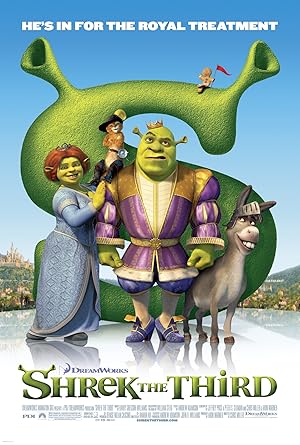
Shrek the Third
Plot
When King Harold (John Cleese) of Far, Far Away dies, the clumsy Shrek (Mike Myers) becomes the immediate successor of the throne. However, Shrek decides to find the legitimate heir Artie (Justin Timberlake) in a distant kingdom with his friends Donkey (Eddie Murphy) and Puss in Boots (Antonio Banderas) to be able return to his beloved house in the swamp with the pregnant Fiona (Cameron Diaz). Meanwhile, the envious and ambitious Prince Charming (Rupert Everett) joins the villains of the fairytales plotting a coup d'état to become the new King.
Get the Weekly Woke Watchlist
New and trending movies scored for woke bias, preachy messaging, and forced political themes — before you waste your evening.
No spam. One useful email per week.
Overall Series Review
Categorical Breakdown
The film criticizes an elitist, appearance-based hierarchy, not one based on real-world racial intersectionality. The villain, Prince Charming, embodies the entitled white male archetype of classic fairytales, and he is depicted as a narcissistic and incompetent failure. The hero, Shrek, an ogre, champions character over looks, and the future king, Artie, is introduced as a scrawny, underachieving high school outcast. The moral conclusion is that character, regardless of physical ‘otherness’ or social status, is the only measure of worth.
The main character, Shrek, rejects the traditional institution of monarchy and the sophisticated, European-coded high society of Far, Far Away, which is portrayed as stressful and inauthentic. His ultimate goal is to return to his swamp, prioritizing a simple, private life over a civilizational role. This promotes an anti-establishment and anti-high-society critique, though the new King, Artie, ends up reforming the kingdom to be more inclusive, preventing a complete demonization of the institution itself.
Fiona and the group of classic princesses form an empowered 'Action Girl' resistance group who refuse to be passive damsels, directly challenging and satirizing the traditional, passive female roles. However, Fiona’s arc is also centered on her pregnancy, and the film concludes with Shrek fully accepting his role as a father, raising the new ogre triplets with Fiona, which results in a strong pro-natal and pro-family message.
The story operates entirely within a normative framework of male-female pairings and the nuclear family, culminating in the birth of Shrek and Fiona’s children. Alternative sexualities or explicit gender ideology are absent from the narrative. A body-switching gag between two male sidekicks is purely a magical mishap for temporary comedy, not a statement on identity.
Religious faith or traditional Christian morality are not central to the film’s narrative or conflict. Morality is defined by a clear, objective good (Shrek and his friends) versus evil (Prince Charming and his villain army). The world is populated by fantastical fairytale tropes, and the concept of 'happily ever after' is treated as a secular, self-centered desire to be achieved, not a spiritual or religious mandate. Magic is a tool used by characters like the hippie-coded Merlin.
Get the Weekly Woke Watchlist
New and trending movies scored for woke bias, preachy messaging, and forced political themes — before you waste your evening.
No spam. One useful email per week.