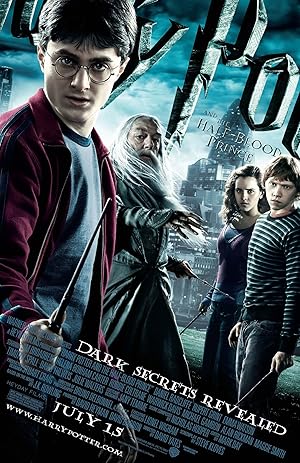
Harry Potter and the Half-Blood Prince
Plot
During Harry Potter's sixth year at Hogwarts, he finds a book that once belonged to the mysterious Half-Blood Prince that earns him the respect of his new Potions professor Horace Slughorn. In addition, Dumbledore must prepare Harry for the ultimate final confrontation by finding out the secret behind Voldemort's power. Meanwhile, a hidden enemy waits in the shadows to carry out a mission given to him by the Dark Lord.
Get the Weekly Woke Watchlist
New and trending movies scored for woke bias, preachy messaging, and forced political themes — before you waste your evening.
No spam. One useful email per week.
Overall Series Review
Categorical Breakdown
The central conflict is a war against a villain who practices a supremacist ideology based on a blood-status hierarchy, which is a clear allegory for real-world racism and bigotry. The narrative consistently champions universal meritocracy, judging characters solely by their choices, bravery, and the content of their soul. The film's cast reflects a generally color-blind approach to the source material, and no plot point exists to lecture the audience on a modern intersectional hierarchy.
The institutions of the wizarding world, specifically the school of Hogwarts and the family unit of the protagonists, are positioned as the last defense against a tyrannical Dark Lord. While the current Ministry of Magic is shown to be incompetent and prone to paranoia, this is a critique of a specific government's failure, not a condemnation of the entire Western/Wizarding civilization or its heritage. Ancestors are respected for their sacrifices, and the setting is a traditional one to be protected from deconstruction.
Female characters like Hermione Granger and Ginny Weasley are highly capable, intelligent, and play pivotal roles in the overall fight against evil. However, the film's gender dynamics largely follow a complementary structure. Hermione is notably depicted as emotionally distressed and focused on romance plots, and the male protagonist remains the central hero. Motherhood (Lily Potter's sacrifice, Molly Weasley's protective ferocity) is portrayed as a source of immense magical and moral strength, avoiding anti-natalist messaging.
The main focus of the teenage side-plot is on traditional male-female pairings (Harry/Ginny, Ron/Lavender/Hermione). The film presents a strictly heteronormative structure, focusing entirely on heterosexual relationships. There is no presence of alternative sexual or gender identity ideology, nor is there any deconstruction or critique of the nuclear family unit.
The narrative is driven by an objective, transcendent moral structure where love, sacrifice, and the choice between good and evil determine a character’s fate. The villain is destroyed by his pursuit of material immortality and fear of death, while the heroes are protected by a force of selfless love. This is a story of ultimate moral law, not moral relativism, and there is no hostility or critique directed toward traditional religious faith.
Get the Weekly Woke Watchlist
New and trending movies scored for woke bias, preachy messaging, and forced political themes — before you waste your evening.
No spam. One useful email per week.