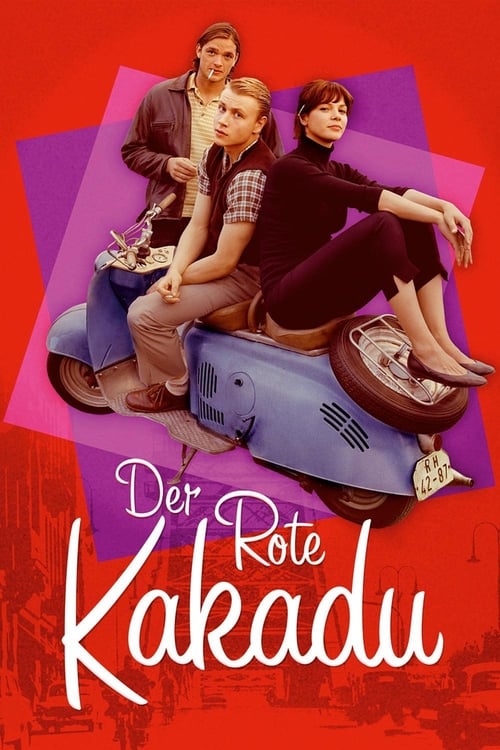
The Red Cockatoo
Plot
A coming-of-age story set in Germany in the 1960s. Siggi becomes involved in a love triangle when he falls for Luise, but the tightening political climate forces him to make a fateful decision.
Get the Weekly Woke Watchlist
New and trending movies scored for woke bias, preachy messaging, and forced political themes — before you waste your evening.
No spam. One useful email per week.
Overall Series Review
Categorical Breakdown
The narrative is fundamentally centered on an ideological and political conflict between the individual (Siggi, Luise, Wolle) and the oppressive, coercive state, not on immutable characteristics or an intersectional hierarchy. Character value is defined by the merit of one's commitment to freedom and art versus one's willingness to compromise with the state. There is no vilification of 'whiteness' or forced diversity; the cast is historically authentic to 1961 East Germany.
The film delivers a sharp critique of the East German communist regime, framing it as corrupt and repressive for suppressing art, rock and roll, and personal freedom. This is hostility toward a *specific political institution* within the home culture, not Western civilization as a whole. The youth counter-culture actually champions 'Westernized' elements like rock and roll and individualism, which are viewed as superior to the state's official 'Soviet collectivist folk art' demands.
The female lead, Luise, is a strong character who is a 'free spirited poet' and the intellectual/romantic catalyst for the protagonist's development and the plot's climax. She exists in a non-normative love triangle with two men, challenging the traditional family structure. However, she is not presented as a perfect 'Mary Sue' whose sole purpose is to emasculate men. Her husband, Wolle, is a charismatic and politically active rebel. The focus is on sexual and artistic liberation, not a systematic denigration of masculinity or an anti-natalist message.
The story features a central, non-normative heterosexual love triangle that directly challenges the traditional male-female pairing and nuclear family as the standard within the bohemian group. This transgression is an element of the counter-culture's pursuit of sexual and romantic freedom. However, the narrative does not center sexual identity as a political ideology, nor does it lecture on gender theory or the deconstruction of biological reality.
Religious themes are absent from the narrative; the core conflict is purely political, ideological, and existential. The film's morality is focused on personal choice, non-compromise, and self-fulfillment in the face of state coercion. There is no evidence of hostility toward religion, and the moral crisis is political rather than theological.
Get the Weekly Woke Watchlist
New and trending movies scored for woke bias, preachy messaging, and forced political themes — before you waste your evening.
No spam. One useful email per week.