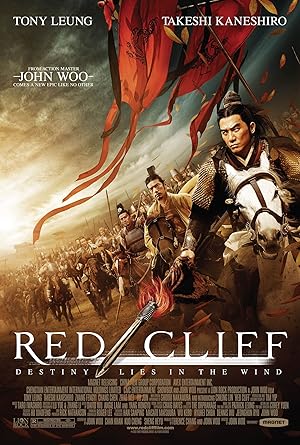
Red Cliff
Plot
In 208 A.D., in the final days of the Han Dynasty, shrewd Prime Minster Cao Cao convinced the fickle Emperor Han the only way to unite all of China was to declare war on the kingdoms of Xu in the west and East Wu in the south. Thus began a military campaign of unprecedented scale, led by the Prime Minister, himself. Left with no other hope for survival, the kingdoms of Xu and East Wu formed an unlikely alliance. Numerous battles of strength and wit ensued, both on land and on water, eventually culminating in the battle of Red Cliff. During the battle, two thousand ships were burned, and the course of Chinese history was changed forever.
Get the Weekly Woke Watchlist
New and trending movies scored for woke bias, preachy messaging, and forced political themes — before you waste your evening.
No spam. One useful email per week.
Overall Series Review
Categorical Breakdown
The casting is historically authentic to the Chinese setting, featuring East Asian actors portraying East Asian historical figures from the Three Kingdoms period. The primary conflict is regional and political, focused on rival warlords and the concept of national unification or division. Character value is entirely based on military merit, strategic intellect, and personal loyalty, not on any hierarchy of immutable characteristics or modern racial grievances. The narrative contains no discussion or vilification of 'whiteness' or forced contemporary 'diversity' insertions.
The film functions as a celebration of Chinese history, culture, and ancient military tradition. It showcases the architectural, philosophical, and military ingenuity of its civilization with great admiration, focusing on the defense of the homeland against a tyrannical usurper. The protagonists are motivated by a deep sense of duty and a desire to protect their people and culture. Institutions like the kingdom, the military, and the family are portrayed as valuable shields against the chaos of war.
Female characters are given expanded, decisive roles compared to the source material. Sun Shangxiang is a highly competent Action Girl and Lady of War who commands an Amazon Brigade and performs a critical espionage mission. Xiao Qiao is an intelligent, virtuous wife who demonstrates strategic acumen and takes a profound, independent political risk by confronting the antagonist. However, the male leads are uniformly competent heroes, and masculinity (military courage, brotherhood, and strategy) is celebrated. Motherhood is subtly acknowledged as a source of strength, balancing the powerful female roles without demonizing men or the nuclear family structure.
The narrative adheres to a normative structure where all romantic and family relationships are heterosexual. Sexuality is a private aspect of the main characters' lives, and the plot contains no explicit content or lecturing on alternative sexual identities, queer theory, or gender fluidity. The focus remains on a historical military conflict.
The movie is set within a traditional Chinese cultural context that references ancient philosophy (Taoist cosmology, *The Art of War*) and concepts of honor and justice. Morality is transcendent, based on clear good-versus-evil framing where the ambitious, tyrannical Cao Cao is the villain and the allied warlords are motivated by protecting the vulnerable. There is no evidence of hostility toward faith, and no Christian or religious characters are present to be vilified. Morality is objective, based on loyalty and protection of the people.
Get the Weekly Woke Watchlist
New and trending movies scored for woke bias, preachy messaging, and forced political themes — before you waste your evening.
No spam. One useful email per week.