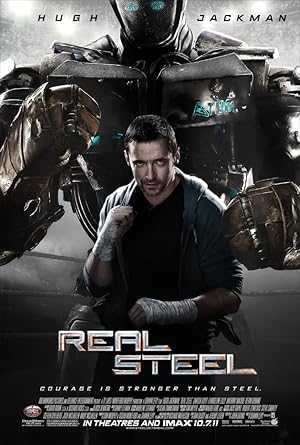
Real Steel
Plot
In the near future when people become uninterested in boxing and similar sports, a new sport is created - Robot boxing wherein robots battle each other while being controlled by someone. Charlie Kenton, a former boxer who's trying to make it in the new sport, not only doesn't do well, he is very deeply in the red. When he learns that his ex, mother of his son Max, dies, he goes to figure out what to do with him. His ex's sister wants to take him in but Charlie has first say in the matter. Charlie asks her husband for money so he can buy a new Robot in exchange for turning Max over to them. He takes Max for the summer. And Max improves his control of his robot. But when the robot is destroyed, they go to a scrap yard to get parts. Max finds an old generation robot named Atom and restores him. Max wants Atom to fight but Charlie tells him he won't last a round. However, Atom wins. And it isn't long before Atom is getting major bouts. Max gets Charlie to teach Atom how to fight, and the father and son bond strenghtens.
Get the Weekly Woke Watchlist
New and trending movies scored for woke bias, preachy messaging, and forced political themes — before you waste your evening.
No spam. One useful email per week.
Overall Series Review
Categorical Breakdown
The narrative is driven by a universal meritocracy story, where the 'underdog' robot Atom succeeds based on Max's tenacity and Charlie's old-school boxing training, not on immutable characteristics or identity. The central struggle is a classic David vs. Goliath/class conflict between the scrappy, low-tech team and the wealthy, corporate elite, which is a common sports movie trope, not an intersectional lecture on race or systemic oppression.
The movie does not express hostility toward Western civilization. It juxtaposes the authentic, traditional American settings like county fairs with the glossy, corporate modernity of the professional robot boxing league. The entire redemptive arc is a celebration of the 'old school' human element—Charlie's boxing heritage and the father-son bond—winning out over the cold, consumerist high-tech future, which acts as a shield against the chaos of technological excess.
The core plot celebrates the repair of the nuclear family through the father-son bond, where the male protagonist, Charlie, completes an arc of redemption from a bumbling, irresponsible man to a protective, responsible father. The female lead, Bailey, is a competent, independent gym owner tied to the family legacy, and her role is complementarian, supporting Charlie's moral and professional resurgence rather than emasculating him or being an instant 'Mary Sue.'
The film maintains a normative structure, with all relationship dynamics being heterosexual and the narrative focusing entirely on the repair of the traditional nuclear family unit between a father and son. There is no deconstruction of the nuclear family or the presence of sexual or gender ideology being centered or lectured to the audience.
The film is centered on a theme of moral redemption and finding personal responsibility, adhering to a transcendent moral law over subjective relativism. Before the final match, the main character explicitly tells his son to pray, which directly acknowledges faith as a source of strength, placing the film at the opposite end of the spectrum from anti-theism.
Get the Weekly Woke Watchlist
New and trending movies scored for woke bias, preachy messaging, and forced political themes — before you waste your evening.
No spam. One useful email per week.