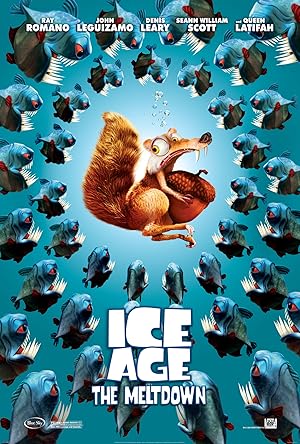
Ice Age: The Meltdown
Plot
Manny the woolly mammoth, Sid the sloth, Diego the saber-toothed tiger, and the hapless prehistoric squirrel/rat known as Scrat are still together and enjoying the perks of their now melting world. Manny may be ready to start a family, but nobody has seen another mammoth for a long time; Manny thinks he may be the last one. That is, until he miraculously finds Ellie, the only female mammoth left in the world. Their only problems: They can't stand each other--and Ellie somehow thinks she's a possum! Ellie comes with some excess baggage in the form of her two possum "brothers"-- Crash and Eddie, a couple of daredevil pranksters and cocky, loud-mouthed troublemakers. Manny, Sid and Diego quickly learn that the warming climate has one major drawback: A huge glacial dam holding off oceans of water is about to break, threatening the entire valley. The only chance of survival lies at the other end of the valley. So our three heroes, along with Ellie, Crash and Eddie, form the most unlikely family--in any "Age"-- as they embark on a mission across an ever-changing, increasingly dangerous landscape towards their salvation.
Get the Weekly Woke Watchlist
New and trending movies scored for woke bias, preachy messaging, and forced political themes — before you waste your evening.
No spam. One useful email per week.
Overall Series Review
Categorical Breakdown
The narrative is based on species survival, not human-based intersectional identity. Characters are judged solely on their merit, courage, and loyalty to the 'herd.' The conflict is the difference between biological identity and adopted identity, which is resolved by the acceptance of biological reality while retaining the adopted family (the possums), promoting universal inclusion rather than an anti-meritocracy hierarchy.
The plot is a survival story where the characters fight to save themselves from a natural disaster (the melting ice) and relocate to safety, not a deconstruction of their culture or home. The theme is about enduring the chaos of nature and respecting the protective unit of the family and herd. No ancestors or home culture are demonized.
The main male character, Manny, is depicted as the protective leader of the herd who is explicitly driven by a desire to mate and propagate his species, which counters an anti-natalist message. The main female character, Ellie, is strong and capable but her arc involves realizing her true identity and accepting a complementary relationship with Manny, forming a new nuclear family unit. Masculinity is protective and celebrated.
The core plot is entirely focused on the traditional male-female pairing of Manny and Ellie to ensure species survival. The overall resolution affirms a normative structure of a male and female partner forming a family (the herd). There is no centering of alternative sexualities or political lecturing on gender theory.
The film contains no overt religious commentary or hostility toward faith. Morality is transcendent, based on objective virtues such as courage, loyalty, self-sacrifice, and protecting the vulnerable. The survival plot, with its flood and ark-like escape, obliquely references a transcendent moral order.
Get the Weekly Woke Watchlist
New and trending movies scored for woke bias, preachy messaging, and forced political themes — before you waste your evening.
No spam. One useful email per week.