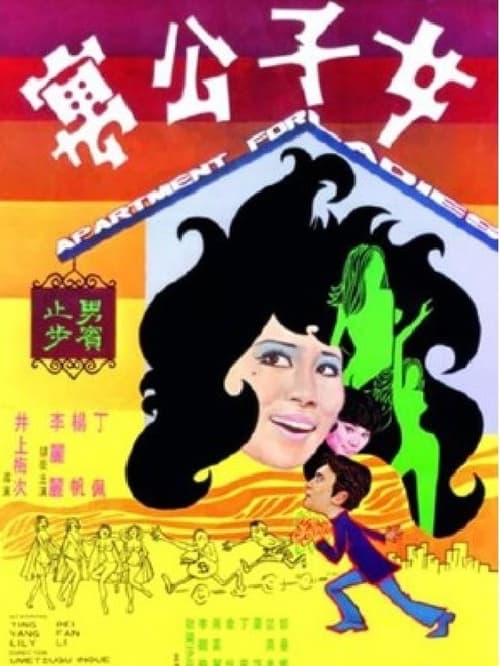
Apartment for Ladies
Plot
Betty Ting Pei plays the lead, a Taiwanese singer searching in Hong Kong for her younger sister, who disappears after coming to HK to be discovered as a nightclub singer.
Get the Weekly Woke Watchlist
New and trending movies scored for woke bias, preachy messaging, and forced political themes — before you waste your evening.
No spam. One useful email per week.
Overall Series Review
Categorical Breakdown
The entire cast and crew are East Asian (Hong Kong/Taiwanese/Japanese), and the film contains no references to "whiteness" or the concept of Western-style privilege or systemic oppression. Characters are not defined by an intersectional hierarchy of immutable characteristics like race or color, but by their moral character and gender. The casting is naturally authentic to the 1970 Hong Kong setting.
The film is a genre picture set in Hong Kong and offers a critique of the "seamy side" and the predatory nature of the nightclub industry, but this is a specific social critique, not a wholesale condemnation of the culture or ancestors. The film portrays the dangers of the city but simultaneously celebrates community and sisterhood as a positive institutional shield against chaos. The setting is shown with "splendors—and dangers," indicating a mixed, not fundamentally hateful, view of the home culture.
The entire plot structure is based on the necessity of female solidarity against generalized male evil, which is a 10/10 level of gender vilification. A main character is violently assaulted by a street gang, which sets the tone for the perceived danger men pose. The female collective is run by a landlady who "despises men," and the apartment's security is likened to having "prison bars" to protect the women from "predatory men." Male characters are systematically emasculated, generally serving only as one-dimensional, non-threatening romantic figures or as bumbling antagonists, while the women are the central, capable, and complex drivers of the plot.
The film is a 1970s Hong Kong production focused entirely on the heteronormative dynamic between men and women, albeit a conflictual one. There is no presence of sexual ideology, centering of alternative sexualities, deconstruction of the nuclear family, or discussion of gender theory. The narrative is entirely concerned with traditional male-female pairing and courtship, which is framed as a constant struggle for the women to navigate safely.
As a secular Shaw Brothers genre film, the narrative does not engage with religious themes at all. There is no depiction of religion, moral relativism, or hostility toward faith systems, Christian or otherwise. The film’s morality is based on social good and the protection of a sibling, which falls outside the realm of religious or anti-theistic discourse.
Get the Weekly Woke Watchlist
New and trending movies scored for woke bias, preachy messaging, and forced political themes — before you waste your evening.
No spam. One useful email per week.