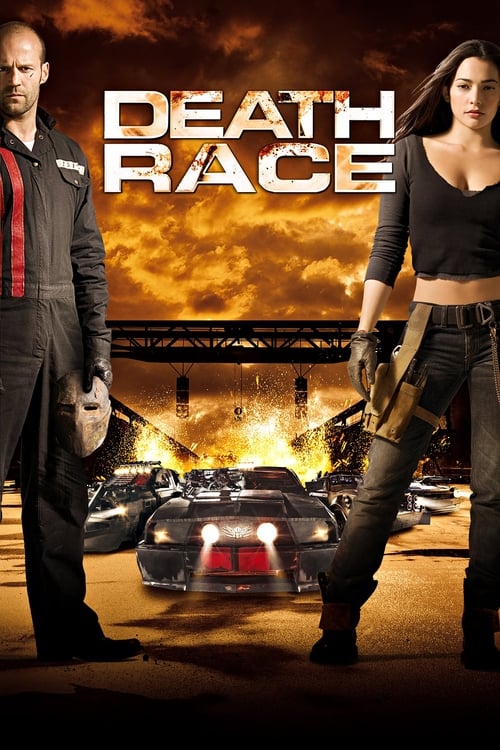
Death Race
Plot
Terminal Island, New York: 2020. Overcrowding in the US penal system has reached a breaking point. Prisons have been turned over to a monolithic Weyland Corporation, which sees jails full of thugs as an opportunity for televised sport. Adrenalized inmates, a global audience hungry for violence and a spectacular, enclosed arena come together to form the 'Death Race', the biggest, most brutal event.
Get the Weekly Woke Watchlist
New and trending movies scored for woke bias, preachy messaging, and forced political themes — before you waste your evening.
No spam. One useful email per week.
Overall Series Review
Categorical Breakdown
Characters are defined by their criminal personas, driving skill, and their role in the plot, adhering to a universal meritocracy of violence and mechanical competence. The prison population and race drivers are racially diverse, including a white protagonist, a black rival who becomes an ally, and Asian and Hispanic racers. This diversity is organically inserted into the prison setting without any narrative focus on systemic oppression based on race or intersectional hierarchy. The white supremacist prison gang, the 'Aryan Brotherhood,' is explicitly portrayed as an antagonist force, which is a standard prison trope.
The film sets its dystopia on American soil, criticizing the American political system's collapse into corporate-run, privatized prisons that exploit human life for entertainment. This is a pointed critique of failing national institutions and corporate power, not an attack on Western civilization’s heritage, ancestors, or founding principles. The hero's primary motivation is to escape the corrupt system with his daughter, which is an indictment of the dystopian present, not a rejection of the past.
The gender dynamics are overtly non-woke. The ultimate villain, Warden Hennessey, is a woman in a position of authority who is portrayed as a 'dragon lady' and a cruel, amoral corporate tyrant, which actively subverts the 'Girl Boss' trope by making the powerful woman irredeemably evil. The other significant female characters, the navigators, are introduced as 'scorching hot female inmates' and are primarily relegated to highly sexualized, subservient roles as co-pilots and eye-candy, entirely in opposition to the 'Mary Sue' archetype. The protagonist's core motivation is to avenge his wife and return to his newborn daughter, which is a strongly pro-natal and pro-family theme.
The core narrative structure is heterosexual, with the hero motivated by his nuclear family. There is no deconstruction of the nuclear family. A rival racer, Machine Gun Joe, is described as a 'gay badass' in supplemental materials, but his sexuality is a minor character trait that is not centered, lectured on, or used as a source of conflict. The presence is minimal and non-ideological.
Religion and faith are virtually absent from the film's primary conflict. The antagonist system is driven purely by corporate greed and a depraved audience's desire for blood sport, which is a moral vacuum, but not one directly opposed to a specific religion. Morality is objective within the narrative: the corporation/warden is evil, and the hero seeking justice/freedom is good. The film focuses on secular, materialistic evil rather than an attack on traditional religion.
Get the Weekly Woke Watchlist
New and trending movies scored for woke bias, preachy messaging, and forced political themes — before you waste your evening.
No spam. One useful email per week.