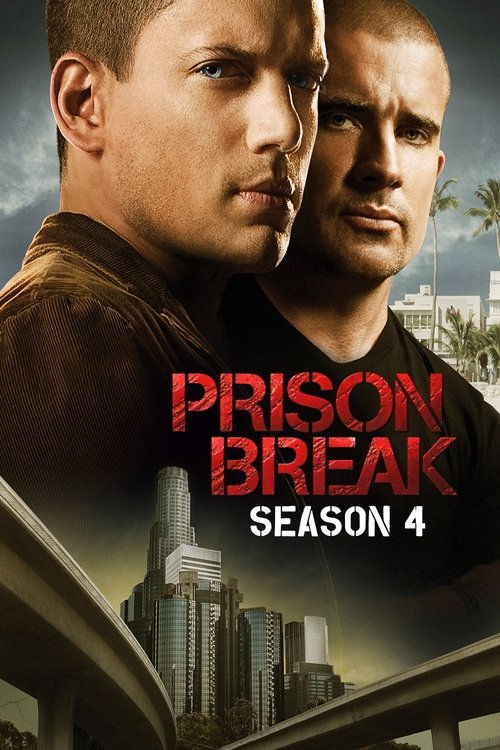
Prison Break
Season 4 Analysis
Season Overview
After engineering a daring escape from the hellish, Panamanian prison Sona, brothers Michael Scofield and Lincoln Burrows are determined to seek justice against The Company, the shadowy group responsible for destroying their lives and killing the woman Michael loves, Dr. Sara Tancredi. Michael’s quest for vengeance leads him to Los Angeles, where his world is turned upside down when Company operative Gretchen/Susan B. Anthony informs him that Sara is still alive. Realizing the only way they will truly be free, Michael and Lincoln avow to find Sara and take down The Company. With the help of Homeland Security agent Don Self, they assemble a group of allies and familiar faces to accomplish their task: Mahone, Sucre, Bellick and computer expert Roland Glenn. Unfortunately for the brothers, they must also evade company assassin Wyatt and find an on-the-loose T-Bag. Michael and Lincoln soon discover the only thing harder than breaking out will be breaking in.
Season Review
Categorical Breakdown
The core team's success is based solely on individual merit and specialized skills, not immutable characteristics. The new team member, Roland Glenn, is an expert computer hacker who is judged on his utility and not his race. Villains and heroes are diverse, from the white male General Krantz to the Black assassin Wyatt, demonstrating that moral alignment is unrelated to race. The central conflict is a universal fight against a corrupt elite, entirely avoiding themes of systemic oppression or intersectional hierarchy.
The central enemy is 'The Company,' a deep-state conspiracy that has infiltrated and corrupted key elements of the American government and powerful international organizations. The narrative frame is that this Company is an anomaly that must be exposed and defeated, allowing the heroes to appeal to a functional form of government (Agent Kellerman's intervention) for true justice and freedom. This targets the corruption of individuals, not the fundamental corruption of Western civilization itself.
Female characters like Sara Tancredi function primarily as the moral compass and romantic anchor, while the hyper-competent female operative Gretchen Morgan is consistently portrayed as a formidable, amoral villain, not a celebrated 'Girl Boss' icon. The main protagonist, Michael Scofield, is physically frail but remains the intellectual mastermind, and his brother Lincoln is the indispensable protector. The dynamic centers on the complementarity of Michael's mind and Lincoln's strength, maintaining a traditional balance of masculine roles. The pursuit of a family future is a clear motivation for the lead characters.
The series focuses exclusively on action, conspiracy, and the heterosexual relationships of the lead characters. The normative structure of the family unit, particularly Michael and Sara's relationship and Sucre's commitment to his fiancée and child, is a key non-ideological motivation. Alternative sexualities and gender theory are entirely absent from the plot, character development, and theme.
The moral framework of the series is rooted in objective good and evil, with the characters constantly making high-stakes moral choices to pursue justice and protect family, which represents a transcendent moral good. The concept of sacrifice, particularly Michael’s ultimate act, is treated as the highest form of virtue. The villains are defined by their greed and willingness to discard human life for power (Scylla), establishing a clear-cut objective moral law for the audience to follow.