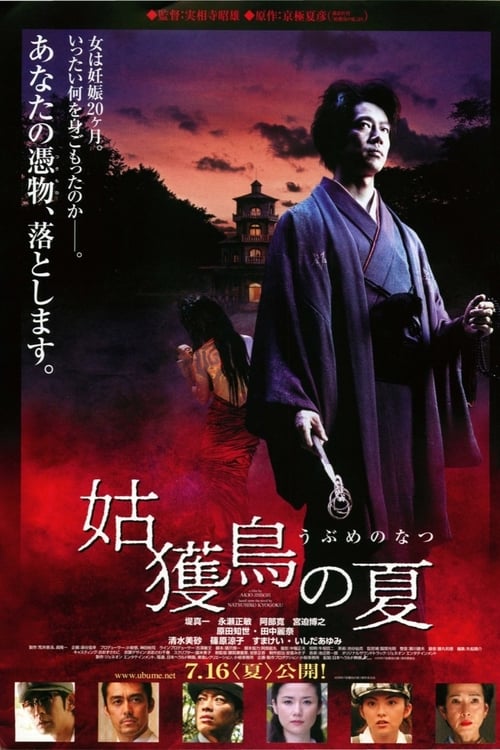
Summer of Ubume
Plot
Kyogokudo is a used book seller who doubles as an onmyouji, or Heian style occultist. His friend Sekiguchi brings him the story of a woman who has been pregnant for twenty months. Sekiguchi investigates further with the help of his friend Enokizu, a detective with the unusual ability to see people's memories. They are hired by the impossibly pregnant woman's sister to find the woman's missing husband and lay this whole matter to rest. In the end, they need the help of Kyogokudo to exorcise the family curse.
Get the Weekly Woke Watchlist
New and trending movies scored for woke bias, preachy messaging, and forced political themes — before you waste your evening.
No spam. One useful email per week.
Overall Series Review
Categorical Breakdown
The film is set in 1952 Japan and features an entirely Japanese cast dealing with domestic folklore and cultural issues, providing no discernible critique based on a Western intersectional lens. Characters are valued based on their skills and philosophical perspective, such as Kyogokudo's intellect, reflecting a universal meritocracy.
The narrative is set during post-war Japan's social upheavals and critiques elements of its own culture, specifically the 'relentless cruelty masked as tradition' within the gothic Kuonji family. This is an internal critique of non-Western culture, not a hostility toward Western civilization or ancestors as defined in the category, resulting in a very low score.
The core mystery involves the *ubume* (a yokai representing the ghost of a woman who died in childbirth) and the plot's resolution stems from a destructive, repressive traditional family dynamic, which is critical of the traditional institution of family/motherhood. However, the intellectual heavy lifting and solving of the mystery are carried out by the male characters, not a female 'Girl Boss' figure.
The plot centers entirely on a mysterious, traditional male-female marriage and an impossible pregnancy. There are no elements of alternative sexualities being centered, gender ideology, or a deliberate deconstruction of the nuclear family as an oppressive structure.
The main intellectual protagonist, Kyogokudo, is explicitly an 'atheist occult consultant' who uses his knowledge of folklore to rationalize and psychologically 'cure' clients, not genuinely exorcise demons. The film's philosophy is an extended argument for a rationalist and psychological materialist view of reality, explicitly stating that all supernatural phenomena, religion, and curses are merely 'social and cultural constructs' or collective delusions, which is a strong philosophical deconstruction of transcendent morality and faith.
Get the Weekly Woke Watchlist
New and trending movies scored for woke bias, preachy messaging, and forced political themes — before you waste your evening.
No spam. One useful email per week.