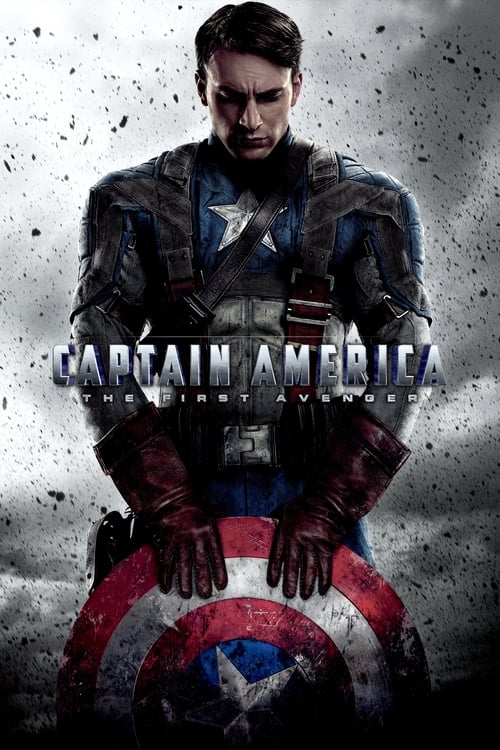
Captain America: The First Avenger
Plot
During World War II, Steve Rogers is a sickly man from Brooklyn who's transformed into super-soldier Captain America to aid in the war effort. Rogers must stop the Red Skull – Adolf Hitler's ruthless head of weaponry, and the leader of an organization that intends to use a mysterious device of untold powers for world domination.
Get the Weekly Woke Watchlist
New and trending movies scored for woke bias, preachy messaging, and forced political themes — before you waste your evening.
No spam. One useful email per week.
Overall Series Review
Categorical Breakdown
The hero, Steve Rogers, is chosen for the super-soldier program explicitly based on the content of his character and moral fiber, demonstrating universal meritocracy. The frail, pre-serum Steve repeatedly attempts to enlist because of a desire to stand up to bullies, a virtue-based motivation. There is no focus on race or intersectional hierarchy; the primary cast is historically authentic to the 1940s setting.
The film is an overt celebration of American patriotism and values, framing the war as a moral crusade against a 'sacred evil' in Nazism and Hydra. Captain America's uniform is a literal flag, and his purpose is to defend the American nation and its ideals. The villain, Red Skull, is an explicit anti-nationalist who proclaims, 'There are no flags,' a vision that Captain America flatly rejects, affirming the value of the nation.
Peggy Carter is introduced as a highly capable and intelligent agent, a professional woman who is not sexualized or incompetent; this grants the film a slightly higher score than an absolute 1. However, the film centers around Steve Rogers' masculine journey of physical transformation and moral leadership, where his strength is protective. The central romantic plot respects traditional male-female pairing and complementarianism, and there is no anti-natal or anti-family messaging.
The story strictly adheres to a normative structure. The central romantic thread is the traditional male-female relationship and yearning between Steve Rogers and Peggy Carter. There is no presence of alternative sexualities, deconstruction of the nuclear family, or any gender ideology lecturing whatsoever. Sexuality is treated as a private and implicitly heterosexual matter in the context of the romantic subplot.
Captain America is portrayed as a God-and-country idealist whose moral code is based on objective truth, duty, and justice. The conflict is a clear, binary struggle between absolute good (Cap’s virtues) and absolute evil (Red Skull’s nihilistic quest for god-like power). Faith and morality are presented as transcendent sources of strength, which is the direct opposite of moral relativism.
Get the Weekly Woke Watchlist
New and trending movies scored for woke bias, preachy messaging, and forced political themes — before you waste your evening.
No spam. One useful email per week.