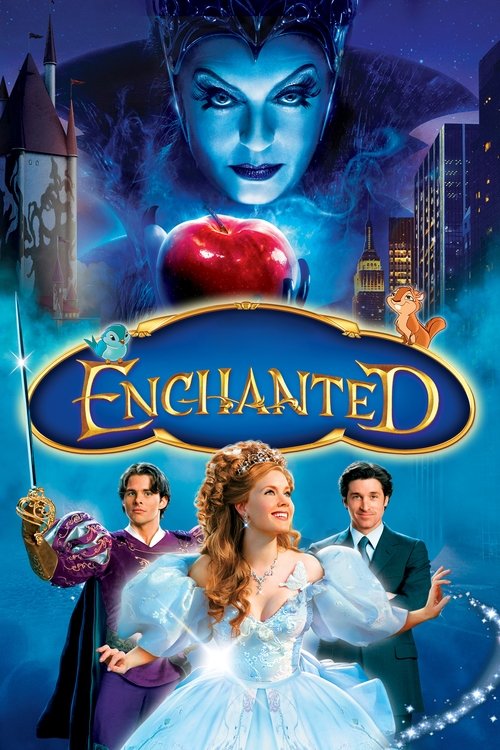
Enchanted
Plot
The beautiful princess Giselle is banished by an evil queen from her magical, musical animated land and finds herself in the gritty reality of the streets of modern-day Manhattan. Shocked by this strange new environment that doesn't operate on a "happily ever after" basis, Giselle is now adrift in a chaotic world badly in need of enchantment. But when Giselle begins to fall in love with a charmingly flawed divorce lawyer who has come to her aid - even though she is already promised to a perfect fairy tale prince back home - she has to wonder: Can a storybook view of romance survive in the real world?
Get the Weekly Woke Watchlist
New and trending movies scored for woke bias, preachy messaging, and forced political themes — before you waste your evening.
No spam. One useful email per week.
Overall Series Review
Categorical Breakdown
The narrative's central conflict is purely ideological, contrasting a fairy tale world with modern life, not an issue of race or intersectional hierarchy. Casting is historically authentic to the fairy tale genre and the New York setting includes organic diversity without political lecturing. Characters are judged entirely on their internal merit and development, such as Giselle's goodness and Robert's pragmatism.
The film does not frame Western culture as fundamentally corrupt or racist. New York City, the representation of the 'Western home,' is initially portrayed as cynical, chaotic, and lacking spirit. However, this culture is ultimately uplifted and improved by the positive influence of Giselle's 'enchantment,' demonstrating a synthesis of values where the modern world is not destroyed but redeemed. The film respects the sacrifices of Robert, a single father, by validating his personal moral framework.
The score is elevated because the movie subverts the classic 'damsel in distress' trope, with Giselle actively fighting the villain at the climax to save Robert. The male figures are not universally emasculated; Prince Edward is an amusingly naive caricature, but Robert is a competent, protective single father who is only 'emasculated' in the sense that he must learn to be more emotionally open. The film celebrates motherhood, as Giselle becomes a loving stepmother, and is not anti-natal, though she does embrace the 'Girl Boss' trope by starting her own successful fashion business.
The story adheres strictly to a normative structure, centered on two heterosexual love stories and the creation of two new nuclear families. The film does not feature alternative sexualities, and the themes of marriage, family, and romance are presented as the standard, without any inclusion of or lecturing on gender theory.
The antagonist is a secular, power-hungry fairy tale witch, not a character representing traditional religion. The film's moral core promotes a belief in transcendent 'true love' and objective good versus evil, which aligns with the principle of a higher moral law. The 'spiritual vacuum' of the modern world (Robert's cynicism) is filled by Giselle's innocent, transcendent faith in goodness, which is treated as a positive force.
Get the Weekly Woke Watchlist
New and trending movies scored for woke bias, preachy messaging, and forced political themes — before you waste your evening.
No spam. One useful email per week.