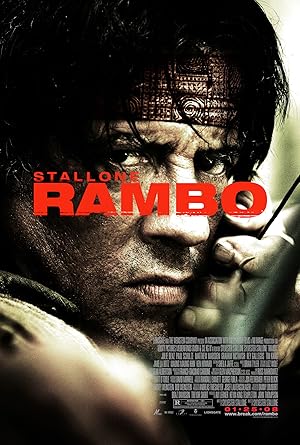
Rambo
Plot
Vietnam veteran John Rambo has survived many harrowing ordeals in his lifetime and has since withdrawn into a simple and secluded existence in Thailand, where he spends his time capturing snakes for local entertainers, and chauffeuring locals in his old PT boat. Even though he is looking to avoid trouble, trouble has a way of finding him: a group of Christian human rights missionaries, led by Michael Burnett and Sarah Miller, approach Rambo with the desire to rent his boat to travel up the river to Burma. For over fifty years, Burma has been a war zone. The Karen people of the region, who consist of peasants and farmers, have endured brutally oppressive rule from the murderous Burmese military and have been struggling for survival every single day. After some inner contemplation, Rambo accepts the offer and takes Michael, Sarah, and the rest of the missionaries up the river. When the missionaries finally arrive at the Karen village, they find themselves part of a raid by the sadistic Major Pa Tee Tint and a slew of Burmese army men. A portion of the villagers and missionaries are tortured and viciously murdered, while Tint and his men hold the remainder captive. Concerned by their disappearance, the minister in charge of the mission gathers a group of mercenaries and pleas Rambo transport them with his boat, since he knows their last exact location. But Rambo can't stay behind: he joins the team where he belongs, to liberate the survivors from the clutches of Major Tint in what may be one of his deadliest missions ever
Get the Weekly Woke Watchlist
New and trending movies scored for woke bias, preachy messaging, and forced political themes — before you waste your evening.
No spam. One useful email per week.
Overall Series Review
Categorical Breakdown
The plot's primary conflict is the defense of an ethnic minority (the Karen people) against a genocidal Burmese military regime. The white American protagonist, Rambo, and a diverse group of mercenaries are depicted as heroes solely based on their merit and willingness to fight. The villains are the non-Western military forces. There is no focus on Western racial hierarchy, vilification of 'whiteness,' or forced insertion of diversity for political purposes.
The film does not promote civilizational self-hatred. Rambo is an American veteran who, after helping to defeat the foreign villains, returns to his family's farm in America, a visual symbol of coming home and finding peace. The Western characters are the Christian missionaries who are presented as naive but fundamentally good, and the mercenaries are the necessary force for justice. The narrative frames American-style, decisive military action as a righteous and necessary intervention against foreign barbarism, not as an extension of Western corruption.
The female lead, Sarah Miller, is the emotional and moral catalyst who convinces Rambo to act, showing moral fortitude. However, she is later captured and subjected to sexual assault, requiring rescue by the male protagonists. The core action and protection are carried out by hyper-masculine men (Rambo and the mercenaries). The dynamic is complementary, with the woman inspiring the man's moral renewal, but ultimately requiring his protective violence, which is the antithesis of the 'Girl Boss' trope.
The movie contains no discernible LGBTQ+ themes, characters, or ideological commentary. The film maintains a completely normative structure, focusing on heterosexual couples (Michael and Sarah) and Rambo's return to his family's home. Sexuality is not a plot point or a subject of ideological debate.
The film depicts Christian human rights missionaries as a good force, committed to transcendent morality and self-sacrifice, even if they are shown to be naive about real-world evil. The antagonist Major Tint and the military are presented as 'anti-religion' and fundamentally evil. While a mercenary expresses atheistic cynicism ('God didn't save you, I did'), the overall narrative values the faith-driven mission enough to justify Rambo's intervention, making faith a source of noble action.
Get the Weekly Woke Watchlist
New and trending movies scored for woke bias, preachy messaging, and forced political themes — before you waste your evening.
No spam. One useful email per week.